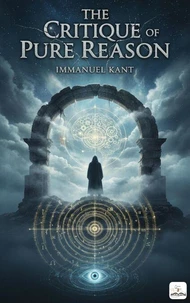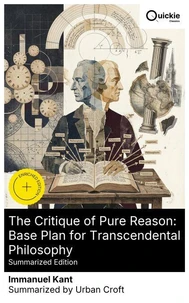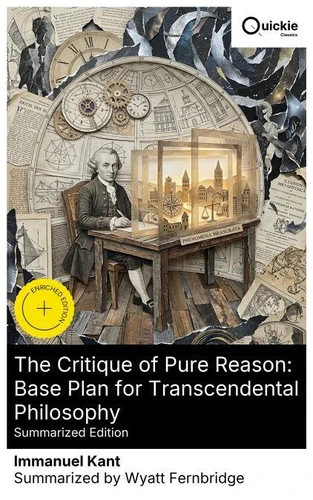
The Critique of Pure Reason: Base Plan for Transcendental Philosophy (Summarized Edition). Enriched edition. A Copernican Revolution in Epistemology and Metaphysics of Mind
Par : , ,Formats :
Disponible dans votre compte client Decitre ou Furet du Nord dès validation de votre commande. Le format ePub est :
- Compatible avec une lecture sur My Vivlio (smartphone, tablette, ordinateur)
- Compatible avec une lecture sur liseuses Vivlio
- Pour les liseuses autres que Vivlio, vous devez utiliser le logiciel Adobe Digital Edition. Non compatible avec la lecture sur les liseuses Kindle, Remarkable et Sony
 , qui est-ce ?
Notre partenaire de plateforme de lecture numérique où vous retrouverez l'ensemble de vos ebooks gratuitement
Pour en savoir plus sur nos ebooks, consultez notre aide en ligne ici
C'est si simple ! Lisez votre ebook avec l'app Vivlio sur votre tablette, mobile ou ordinateur :

- Nombre de pages189
- FormatePub
- ISBN859-65--4789329-5
- EAN8596547893295
- Date de parution08/04/2026
- Protection num.Digital Watermarking
- Taille1 Mo
- Infos supplémentairesepub
- ÉditeurQUICKIE CLASSICS
Résumé
The Critique of Pure Reason: Base Plan for Transcendental Philosophy erects a systematic account of reason's powers and limits at the height of the Enlightenment. Kant vindicates synthetic a priori knowledge and articulates transcendental idealism: objects of experience appear through a priori forms (space, time) and categories of the understanding. Organized as Transcendental Aesthetic, Analytic, and Dialectic-treating the Deduction, Schematism, Paralogisms, Antinomies, and the Ideal-the book secures objective cognition while curbing metaphysical illusion.
Its style is dense, architectonic, and methodical, reflecting exacting philosophical ambition. Immanuel Kant of Königsberg joined pietist rigor to Newtonian science and was galvanized by Hume's skepticism, which "awakened" him from dogmatic slumber. After the 1770 Inaugural Dissertation and a "silent decade" of reflection and lecturing, he forged the transcendental method to explain the conditions of possible experience.
This volume rewards patient, guided study and is indispensable for students of epistemology, metaphysics, and philosophy of science. Read alongside the Prolegomena or a reliable commentary, it offers a demanding yet exhilarating blueprint for disciplining reason in service of knowledge, critique, and moral freedom. Quickie Classics summarizes timeless works with precision, preserving the author's voice and keeping the prose clear, fast, and readable-distilled, never diluted.
Enriched Edition extras: Introduction · Synopsis · Historical Context · Author Biography · Brief Analysis · 4 Reflection Q&As · Editorial Footnotes.
Its style is dense, architectonic, and methodical, reflecting exacting philosophical ambition. Immanuel Kant of Königsberg joined pietist rigor to Newtonian science and was galvanized by Hume's skepticism, which "awakened" him from dogmatic slumber. After the 1770 Inaugural Dissertation and a "silent decade" of reflection and lecturing, he forged the transcendental method to explain the conditions of possible experience.
This volume rewards patient, guided study and is indispensable for students of epistemology, metaphysics, and philosophy of science. Read alongside the Prolegomena or a reliable commentary, it offers a demanding yet exhilarating blueprint for disciplining reason in service of knowledge, critique, and moral freedom. Quickie Classics summarizes timeless works with precision, preserving the author's voice and keeping the prose clear, fast, and readable-distilled, never diluted.
Enriched Edition extras: Introduction · Synopsis · Historical Context · Author Biography · Brief Analysis · 4 Reflection Q&As · Editorial Footnotes.