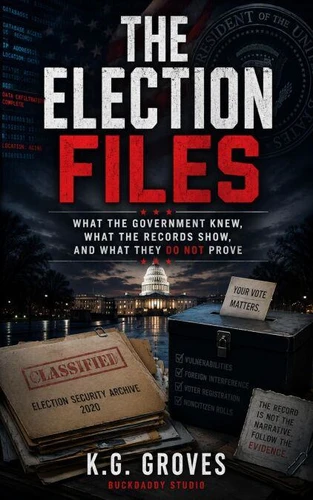
On July 16, 2026, President Donald Trump released four collections of election-related records and promised they would reveal the truth about the 2020 election. The documents were real. The questions were harder. In The Election Files, K. G. Groves follows the evidence through four interconnected archives: federal assessments of voting-system vulnerabilities, Chinese acquisition and analysis of American voter information, the suspicious voter-registration applications discovered in Muskegon, Michigan, and Department of Homeland Security claims involving potential noncitizens and deceased registrants on voter rolls.
The investigation asks what the government knew, what officials withheld, why the FBI closed the Muskegon case, how federal database searches produced enormous citizenship-related totals, and whether any released record establishes that enough unlawful or altered votes existed to change the certified result. Rather than beginning with a partisan verdict, Groves traces the complete chain of proof. A vulnerability is not an exploit.
Data is not the count. A registration is not a ballot. An investigation is not a conviction. A classified warning is not automatically a confession, and a declassified document is not automatically proof of the political interpretation placed above it. The result is a meticulous work of investigative nonfiction that reaches a conclusion more difficult than either side's slogan: the files do not prove that the certified winner of the 2020 presidential election was wrong.
They do prove that serious vulnerabilities existed, foreign governments sought American voter data and political knowledge, suspicious registration activity occurred, government secrecy deepened the crisis, and officials repeatedly failed to explain the difference between a vulnerable election and a stolen one. For readers of current affairs, American political history, election law, intelligence, cybersecurity, government transparency, and documentary investigations, The Election Files offers the record first, the limits second, and the verdict only where the evidence can bear it.
On July 16, 2026, President Donald Trump released four collections of election-related records and promised they would reveal the truth about the 2020 election. The documents were real. The questions were harder. In The Election Files, K. G. Groves follows the evidence through four interconnected archives: federal assessments of voting-system vulnerabilities, Chinese acquisition and analysis of American voter information, the suspicious voter-registration applications discovered in Muskegon, Michigan, and Department of Homeland Security claims involving potential noncitizens and deceased registrants on voter rolls.
The investigation asks what the government knew, what officials withheld, why the FBI closed the Muskegon case, how federal database searches produced enormous citizenship-related totals, and whether any released record establishes that enough unlawful or altered votes existed to change the certified result. Rather than beginning with a partisan verdict, Groves traces the complete chain of proof. A vulnerability is not an exploit.
Data is not the count. A registration is not a ballot. An investigation is not a conviction. A classified warning is not automatically a confession, and a declassified document is not automatically proof of the political interpretation placed above it. The result is a meticulous work of investigative nonfiction that reaches a conclusion more difficult than either side's slogan: the files do not prove that the certified winner of the 2020 presidential election was wrong.
They do prove that serious vulnerabilities existed, foreign governments sought American voter data and political knowledge, suspicious registration activity occurred, government secrecy deepened the crisis, and officials repeatedly failed to explain the difference between a vulnerable election and a stolen one. For readers of current affairs, American political history, election law, intelligence, cybersecurity, government transparency, and documentary investigations, The Election Files offers the record first, the limits second, and the verdict only where the evidence can bear it.

 , qui est-ce ?