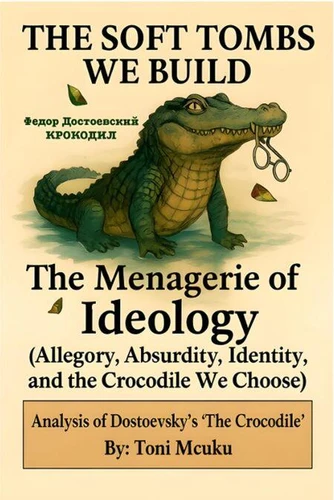
Kierkegaard might have said: 'He has seen the sickness unto death - and named it comfort.' Hamlet proclaimed: 'There are more things in heaven and earth, Horatio, than are dreamt of in your philosophy.' In Dostoevsky's world, that becomes: 'There are more crocodiles in your head than you dare admit to. Your mind is more absurd than your comfort allows.' The Soft Tombs We Build - The Menagerie of IdeologyAllegory, Absurdity, Identity, and the Crocodile We ChooseAnalysis of Dostoevsky's The Crocodile Overview / Context - A Political Menagerie in Two Inches of WaterOn the surface, The Crocodile presents itself as farce - a Gogolian grotesque where a crocodile swallows a bureaucrat, the crowd gawks, and the absurdity spirals into spectacle.
It has long been dismissed as a minor work. As a playful detour in Dostoevsky's career. That reading is too shallow. Beneath the absurd premise lies a compressed psychological and ideological experiment. This is not merely parody - it is dissection. Dostoevsky constructs a miniature ecosystem in which ideology, vanity, jealousy, opportunism, and emotional inertia interact under pressure. Nothing is accidental.
Every reaction is diagnostic. Whilst not 'The Blueprint' of his later work, it is undeniably a controlled environment in which the mechanisms he will later expand are already active. The Crocodile is a political menagerie in two inches of water - shallow in appearance, devastating in implication. Key Themes and Concepts Ideology as Digestive System - how ideology swallows individuals while persuading them that they are being elevated Captivity as Identity - the human instinct to sanctify imprisonment when it provides meaning Performance Over Substance - suffering transformed into spectacle and social currency Jealousy and Emotional Inertia - longing without action; resentment without consequence Opportunism and Social Masks - the rapid conversion of crisis into advantage Psychological Collapse - the moment when fantasy, ideology, and ego implode A Compressed BlueprintWhat appears minor is, in fact, concentrated.
Within this short work are early formations of themes that later expand across Dostoevsky's major novels. This is not a lesser work. It is a compressed one. It's foundational. It is the seed of Dostoevsky's psychological universe. Satire?To call this merely satire is to soften it. If it produces laughter, it is the kind that follows recognition. Dostoevsky is not entertaining absurdity. He is exposing it.
And if the crocodile feels distant - exotic, theatrical, implausible - that distance is precisely the danger. Because the most effective systems do not resemble monsters but comfort. 'The crocodile does not devour the man. The man devours himself. He learns to live inside it - and calls that life'
Kierkegaard might have said: 'He has seen the sickness unto death - and named it comfort.' Hamlet proclaimed: 'There are more things in heaven and earth, Horatio, than are dreamt of in your philosophy.' In Dostoevsky's world, that becomes: 'There are more crocodiles in your head than you dare admit to. Your mind is more absurd than your comfort allows.' The Soft Tombs We Build - The Menagerie of IdeologyAllegory, Absurdity, Identity, and the Crocodile We ChooseAnalysis of Dostoevsky's The Crocodile Overview / Context - A Political Menagerie in Two Inches of WaterOn the surface, The Crocodile presents itself as farce - a Gogolian grotesque where a crocodile swallows a bureaucrat, the crowd gawks, and the absurdity spirals into spectacle.
It has long been dismissed as a minor work. As a playful detour in Dostoevsky's career. That reading is too shallow. Beneath the absurd premise lies a compressed psychological and ideological experiment. This is not merely parody - it is dissection. Dostoevsky constructs a miniature ecosystem in which ideology, vanity, jealousy, opportunism, and emotional inertia interact under pressure. Nothing is accidental.
Every reaction is diagnostic. Whilst not 'The Blueprint' of his later work, it is undeniably a controlled environment in which the mechanisms he will later expand are already active. The Crocodile is a political menagerie in two inches of water - shallow in appearance, devastating in implication. Key Themes and Concepts Ideology as Digestive System - how ideology swallows individuals while persuading them that they are being elevated Captivity as Identity - the human instinct to sanctify imprisonment when it provides meaning Performance Over Substance - suffering transformed into spectacle and social currency Jealousy and Emotional Inertia - longing without action; resentment without consequence Opportunism and Social Masks - the rapid conversion of crisis into advantage Psychological Collapse - the moment when fantasy, ideology, and ego implode A Compressed BlueprintWhat appears minor is, in fact, concentrated.
Within this short work are early formations of themes that later expand across Dostoevsky's major novels. This is not a lesser work. It is a compressed one. It's foundational. It is the seed of Dostoevsky's psychological universe. Satire?To call this merely satire is to soften it. If it produces laughter, it is the kind that follows recognition. Dostoevsky is not entertaining absurdity. He is exposing it.
And if the crocodile feels distant - exotic, theatrical, implausible - that distance is precisely the danger. Because the most effective systems do not resemble monsters but comfort. 'The crocodile does not devour the man. The man devours himself. He learns to live inside it - and calls that life'


 , qui est-ce ?