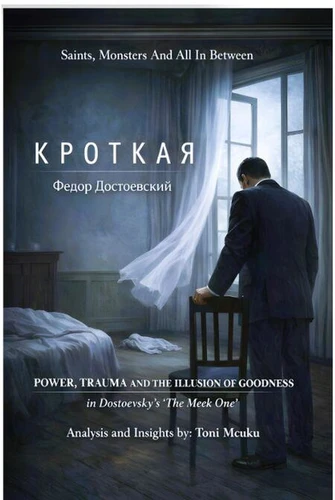
Dostoevsky's The Meek One arrives disguised as confession. A husband speaks into the void after his young wife leaps from the window. His monologue is frantic, circular, self-absolving. But the tragedy does not belong to the man who speaks - it belongs to the woman who never does. What appears to be a domestic tale is, in truth, a psychological crucible. A study of how control masquerades as care.
How silence becomes rebellion. How the desire to be seen as good can become its own quiet form of violence. This is not a story about a meek girl and a stern man. It is a story about possession, interpretation, and the soul's refusal to be owned. Key Themes Silence as Sovereignty - when refusal becomes the last remaining form of agency The Violence of Goodness - how moral self-image becomes a mechanism of domination Intimacy as Ideology - the home as a system of rituals, surveillance, and doctrine Utopia as Escape - fantasies constructed to avoid the risk of real intimacy Suicide as Protest - the leap as metaphysical refusal rather than collapse Beyond the Text - Dostoevsky's Quietest WarningThe Meek One sits at the crossroads of Dostoevsky's obsessions: the seduction of ideology the fragility of the soul the violence of moral pride the danger of saviours the sovereignty of silence It is a ghost story where the ghost is still alive.
A parable of systems that comfort in order to conquer. A warning about the soft forms of tyranny - the ones that whisper rather than strike.
Dostoevsky's The Meek One arrives disguised as confession. A husband speaks into the void after his young wife leaps from the window. His monologue is frantic, circular, self-absolving. But the tragedy does not belong to the man who speaks - it belongs to the woman who never does. What appears to be a domestic tale is, in truth, a psychological crucible. A study of how control masquerades as care.
How silence becomes rebellion. How the desire to be seen as good can become its own quiet form of violence. This is not a story about a meek girl and a stern man. It is a story about possession, interpretation, and the soul's refusal to be owned. Key Themes Silence as Sovereignty - when refusal becomes the last remaining form of agency The Violence of Goodness - how moral self-image becomes a mechanism of domination Intimacy as Ideology - the home as a system of rituals, surveillance, and doctrine Utopia as Escape - fantasies constructed to avoid the risk of real intimacy Suicide as Protest - the leap as metaphysical refusal rather than collapse Beyond the Text - Dostoevsky's Quietest WarningThe Meek One sits at the crossroads of Dostoevsky's obsessions: the seduction of ideology the fragility of the soul the violence of moral pride the danger of saviours the sovereignty of silence It is a ghost story where the ghost is still alive.
A parable of systems that comfort in order to conquer. A warning about the soft forms of tyranny - the ones that whisper rather than strike.

 , qui est-ce ?