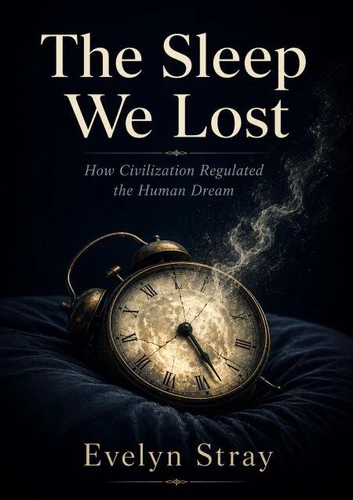
The Sleep We Lost: How Civilization Regulated the Human DreamWhat if everything you believe about sleep is a modern invention?We treat sleep as the most natural thing in the world - close your eyes, drift into eight hours of uninterrupted rest, wake up "recovered." But what if that very model, the one your doctor recommends, your fitness tracker measures, and your guilt punishes you for failing to achieve, is barely two hundred years old?The Sleep We Lost uncovers a hidden history hiding in plain sight: the slow, deliberate transformation of the night from a mysterious, communal, spiritually charged experience into a disciplined biological performance to be optimized, tracked, and judged.
Drawing on the groundbreaking historical research of A. Roger Ekirch and the philosophical lens of Michel Foucault, this book reveals that for most of human history, people didn't sleep the way we do. They slept in two segmented phases - a "first sleep" and a "second sleep" - with a quiet waking hour in between, used for prayer, conversation, intimacy, or simply lying in the dark with one's thoughts.
This rhythm was normal for millennia. Then it vanished. What killed it? Not biology. Civilization did. Artificial light stretched the usable day. Factories demanded punctual, exhausted bodies. Clocks turned time into something to be measured and owned rather than felt. Religious and capitalist moral codes rebranded idleness as failure and discipline as virtue. Medicine stepped in to classify "normal" and "abnormal" rest.
Slowly, the night stopped being a mystery - and became a problem to be managed. This is not a history book that romanticizes the past. Pre-industrial nights were often cold, dangerous, and fearful. But The Sleep We Lost asks a sharper question: if the way we sleep today was manufactured by factories, clocks, and moral panic - then what are we actually obeying when we lie awake at 3 a.m., anxious that we're "doing sleep wrong"?Structured across four compelling parts, the book takes you on a journey: Part I journeys through ancient and medieval sleep cultures - fire, shelter, vulnerability, and the sleeping body as a site of danger and trust.
Part II confronts the Industrial Revolution's quiet war on the night: the clock, the factory whistle, the electric bulb, and the birth of "linear" sleep. Part III enters the world of medicine and psychology, where sleep became a diagnosis, insomnia became a disorder, and the bedroom became a laboratory. Part IV brings us into our own anxious present - sleep trackers, blue-light warnings, melatonin, wellness apps, and a booming industry that profits from a rest it helped make impossible.
Written with the rigor of critical theory and the accessibility of narrative nonfiction, The Sleep We Lost sits at the intersection of history, philosophy, and everyday life. It speaks to anyone who has ever stared at the ceiling at night wondering why rest feels like one more task to fail at - and to anyone curious about how power doesn't just govern nations, but quietly governs bodies, bedrooms, and dreams.
This is more than a book about sleep. It's a book about what it means to be human under civilization - and an invitation to reclaim the night as something more than a performance metric.
The Sleep We Lost: How Civilization Regulated the Human DreamWhat if everything you believe about sleep is a modern invention?We treat sleep as the most natural thing in the world - close your eyes, drift into eight hours of uninterrupted rest, wake up "recovered." But what if that very model, the one your doctor recommends, your fitness tracker measures, and your guilt punishes you for failing to achieve, is barely two hundred years old?The Sleep We Lost uncovers a hidden history hiding in plain sight: the slow, deliberate transformation of the night from a mysterious, communal, spiritually charged experience into a disciplined biological performance to be optimized, tracked, and judged.
Drawing on the groundbreaking historical research of A. Roger Ekirch and the philosophical lens of Michel Foucault, this book reveals that for most of human history, people didn't sleep the way we do. They slept in two segmented phases - a "first sleep" and a "second sleep" - with a quiet waking hour in between, used for prayer, conversation, intimacy, or simply lying in the dark with one's thoughts.
This rhythm was normal for millennia. Then it vanished. What killed it? Not biology. Civilization did. Artificial light stretched the usable day. Factories demanded punctual, exhausted bodies. Clocks turned time into something to be measured and owned rather than felt. Religious and capitalist moral codes rebranded idleness as failure and discipline as virtue. Medicine stepped in to classify "normal" and "abnormal" rest.
Slowly, the night stopped being a mystery - and became a problem to be managed. This is not a history book that romanticizes the past. Pre-industrial nights were often cold, dangerous, and fearful. But The Sleep We Lost asks a sharper question: if the way we sleep today was manufactured by factories, clocks, and moral panic - then what are we actually obeying when we lie awake at 3 a.m., anxious that we're "doing sleep wrong"?Structured across four compelling parts, the book takes you on a journey: Part I journeys through ancient and medieval sleep cultures - fire, shelter, vulnerability, and the sleeping body as a site of danger and trust.
Part II confronts the Industrial Revolution's quiet war on the night: the clock, the factory whistle, the electric bulb, and the birth of "linear" sleep. Part III enters the world of medicine and psychology, where sleep became a diagnosis, insomnia became a disorder, and the bedroom became a laboratory. Part IV brings us into our own anxious present - sleep trackers, blue-light warnings, melatonin, wellness apps, and a booming industry that profits from a rest it helped make impossible.
Written with the rigor of critical theory and the accessibility of narrative nonfiction, The Sleep We Lost sits at the intersection of history, philosophy, and everyday life. It speaks to anyone who has ever stared at the ceiling at night wondering why rest feels like one more task to fail at - and to anyone curious about how power doesn't just govern nations, but quietly governs bodies, bedrooms, and dreams.
This is more than a book about sleep. It's a book about what it means to be human under civilization - and an invitation to reclaim the night as something more than a performance metric.

 , qui est-ce ?