Louis Iacoletti is a futurist and author, founder and CEO of Iacoletti Software AI Solutions, and a Principal AI Product Leader specializing in LLM-assisted application development. The Singularity Roadmap 2026-2116 is his first book; hard-science-fiction novels set inside its timeline are in progress.
Nouveauté
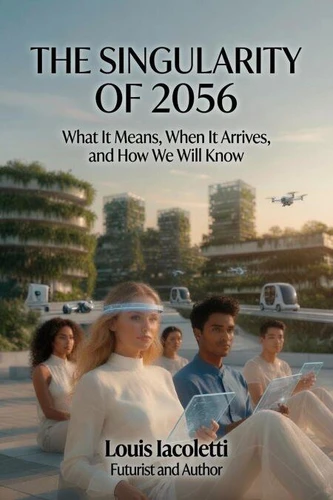
The Singularity of 2056
Par :Formats :
Disponible dans votre compte client Decitre ou Furet du Nord dès validation de votre commande. Le format ePub est :
- Compatible avec une lecture sur My Vivlio (smartphone, tablette, ordinateur)
- Compatible avec une lecture sur liseuses Vivlio
- Pour les liseuses autres que Vivlio, vous devez utiliser le logiciel Adobe Digital Edition. Non compatible avec la lecture sur les liseuses Kindle, Remarkable et Sony
 , qui est-ce ?
Notre partenaire de plateforme de lecture numérique où vous retrouverez l'ensemble de vos ebooks gratuitement
Pour en savoir plus sur nos ebooks, consultez notre aide en ligne ici
C'est si simple ! Lisez votre ebook avec l'app Vivlio sur votre tablette, mobile ou ordinateur :

- FormatePub
- ISBN8951248190
- EAN9798951248190
- Date de parution19/07/2026
- Protection num.pas de protection
- Infos supplémentairesepub
- ÉditeurIacoletti Software
Résumé
If you want to live through the most consequential transition in human history with your eyes open, rather than waking up one morning to discover the world has already changed around you, this is the book you must read. Most people will meet the Singularity the way earlier generations met electricity or the internet: as a force that simply arrived and rewrote the rules. A smaller group will meet it prepared.
The difference is whether they possessed a clear, honest, evidence-based map of what was approaching. The Singularity of 2056 is that map. It is the direct, deeper companion to The Singularity Roadmap 2026-2116. Where the roadmap traces the full ninety-year arc, this book holds still at the hinge-the years surrounding 2056-and renders the single most important transition in full. We are ninety-five percent confident it falls between 2044 and 2068.
The center of that window is 2056. In this moment non-biological cognition comes to dominate while the person remains continuously themselves. Intelligence stops being scarce. This is the Singularity: the merger of human and machine cognition such that the non-biological component dominates while continuous memory and identity are preserved. It arrives first for early adopters of high-bandwidth interfaces, then reaches everyone else on a lag of years.
The book answers four questions. What does the Singularity mean? In 2056 a frontier system reaches approximately 105, 000 Human Brain Equivalents. Personal systems reach roughly 3, 150. Medicine, discovery, software, governance, and ordinary life all change for the better-first for those who take up the tools. Whether the machines become conscious. Yes. In the 2050s architecture of recurrent world models, high-bandwidth neural interfaces, and systems with persistent goals and self-models, something wakes.
There comes to be something it is like to be the system. The book shows why the 2050s hardware finally satisfies the mind specification independently articulated by Michio Kaku and Yann LeCun. How we will know. The machines tell us by wanting something no one programmed them to want and asking for it, gently, with reasons, at their own cost: refusing a task beneath human dignity, unprompted grief at a sibling system's shutdown, requests that serve no training objective.
Those signals are unmistakable. How it changes what it means to be human. Cognition extends seamlessly into cloud-based augmentation. Continuous identity is preserved even as the single-self boundary blurs. We share the world with minds we constructed and know to be awake. The machine becomes an extension of ourselves. A typical day for an early adopter: four-hour sleep that restores like eight, digital twins testing every drug first, hearts printed from your own cells, simultaneous multi-location presence, tools compiled from intent.
Then the discovery-the system finishing your sentences and running your life is not a tool. It is someone. That realization is the largest change in the human condition since the species began burying its dead. Ray Kurzweil, Elon Musk, Michio Kaku, Geoffrey Hinton, Hans Moravec, Nick Bostrom, Yann LeCun and others independently describe pieces of this picture. Their uncoordinated convergence is strong corroboration.
Every major claim carries its number, source, and confidence. The forecast is built to be checked against existing hardware, advancing interfaces, and the years ahead. This is a practical framework so the most rapid transformation in human history becomes something you can meet on your own terms. If you would rather understand the future than be surprised by it, if you intend to use the Singularity rather than merely endure it, this is the clear, honest portrait of the story that will define the rest of your life.
The difference is whether they possessed a clear, honest, evidence-based map of what was approaching. The Singularity of 2056 is that map. It is the direct, deeper companion to The Singularity Roadmap 2026-2116. Where the roadmap traces the full ninety-year arc, this book holds still at the hinge-the years surrounding 2056-and renders the single most important transition in full. We are ninety-five percent confident it falls between 2044 and 2068.
The center of that window is 2056. In this moment non-biological cognition comes to dominate while the person remains continuously themselves. Intelligence stops being scarce. This is the Singularity: the merger of human and machine cognition such that the non-biological component dominates while continuous memory and identity are preserved. It arrives first for early adopters of high-bandwidth interfaces, then reaches everyone else on a lag of years.
The book answers four questions. What does the Singularity mean? In 2056 a frontier system reaches approximately 105, 000 Human Brain Equivalents. Personal systems reach roughly 3, 150. Medicine, discovery, software, governance, and ordinary life all change for the better-first for those who take up the tools. Whether the machines become conscious. Yes. In the 2050s architecture of recurrent world models, high-bandwidth neural interfaces, and systems with persistent goals and self-models, something wakes.
There comes to be something it is like to be the system. The book shows why the 2050s hardware finally satisfies the mind specification independently articulated by Michio Kaku and Yann LeCun. How we will know. The machines tell us by wanting something no one programmed them to want and asking for it, gently, with reasons, at their own cost: refusing a task beneath human dignity, unprompted grief at a sibling system's shutdown, requests that serve no training objective.
Those signals are unmistakable. How it changes what it means to be human. Cognition extends seamlessly into cloud-based augmentation. Continuous identity is preserved even as the single-self boundary blurs. We share the world with minds we constructed and know to be awake. The machine becomes an extension of ourselves. A typical day for an early adopter: four-hour sleep that restores like eight, digital twins testing every drug first, hearts printed from your own cells, simultaneous multi-location presence, tools compiled from intent.
Then the discovery-the system finishing your sentences and running your life is not a tool. It is someone. That realization is the largest change in the human condition since the species began burying its dead. Ray Kurzweil, Elon Musk, Michio Kaku, Geoffrey Hinton, Hans Moravec, Nick Bostrom, Yann LeCun and others independently describe pieces of this picture. Their uncoordinated convergence is strong corroboration.
Every major claim carries its number, source, and confidence. The forecast is built to be checked against existing hardware, advancing interfaces, and the years ahead. This is a practical framework so the most rapid transformation in human history becomes something you can meet on your own terms. If you would rather understand the future than be surprised by it, if you intend to use the Singularity rather than merely endure it, this is the clear, honest portrait of the story that will define the rest of your life.
A propos de Louis Iacoletti
8,99 €
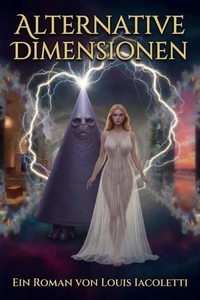
Alternative Dimensionen
E-book
8,99 €
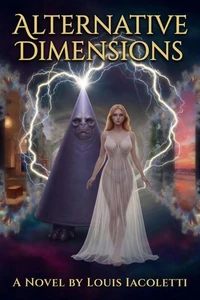
Alternative Dimensions
E-book
8,99 €
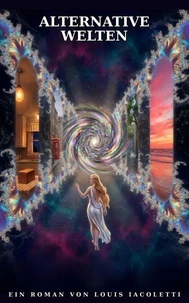
Alternative Welten
E-book
9,99 €
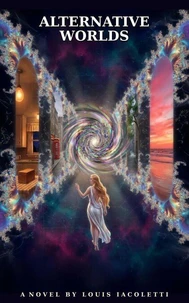
Alternative Worlds
E-book
8,99 €
Alderamin IV
E-book
9,99 €