SOLDES
Jusqu'à -70% sur une sélection d'articles*

Nouveauté
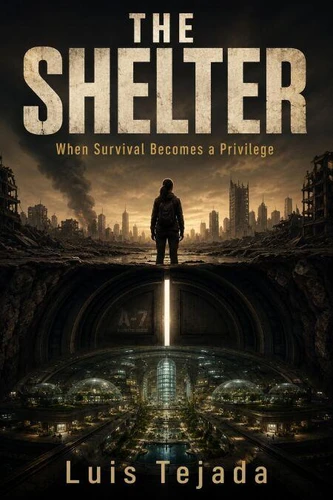
THE SHELTER When Survival Becomes a Privilege
Par :Formats :
Disponible dans votre compte client Decitre ou Furet du Nord dès validation de votre commande. Le format ePub est :
- Compatible avec une lecture sur My Vivlio (smartphone, tablette, ordinateur)
- Compatible avec une lecture sur liseuses Vivlio
- Pour les liseuses autres que Vivlio, vous devez utiliser le logiciel Adobe Digital Edition. Non compatible avec la lecture sur les liseuses Kindle, Remarkable et Sony
 , qui est-ce ?
Notre partenaire de plateforme de lecture numérique où vous retrouverez l'ensemble de vos ebooks gratuitement
Pour en savoir plus sur nos ebooks, consultez notre aide en ligne ici
C'est si simple ! Lisez votre ebook avec l'app Vivlio sur votre tablette, mobile ou ordinateur :

- FormatePub
- ISBN8235899971
- EAN9798235899971
- Date de parution25/06/2026
- Protection num.pas de protection
- Infos supplémentairesepub
- ÉditeurIoakim Ioakim
Résumé
There was a time when humanity believed there would always be a second chance. Every scientific report was met with promises. Every international summit ended with grand speeches. Every natural disaster was treated as an isolated tragedy destined to vanish from the headlines by the following week. For decades, the world mistook the planet's patience for an infinite capacity to endure whatever was inflicted upon it.
It was wrong. The decline did not arrive all at once. There was no single day that could be marked as the beginning of the end. Instead, it came through a thousand small defeats: failed harvests, rivers turning to dust, glaciers vanishing in silence, oceans growing warmer year after year, and entire cities learning to live with floods, wildfires, and unbearable heat. The extraordinary became routine, and routine eventually numbed every instinct to react.
While millions struggled to survive, governments clung to the illusion of control they had long since lost. Economies rested upon increasingly fragile foundations. Supply chains collapsed one after another. Conflicts over water and food replaced the ideological wars of previous generations. The planet kept turning, but the civilization that had dominated it for centuries was beginning to crack. Borders ceased to represent belonging and became desperate walls instead.
Entire families walked for months in search of places where it was still possible to breathe, to grow food, or simply to drink clean water. Refugee camps expanded into improvised cities, while once-great metropolises emptied beneath rising seas and the permanent haze of wildfire smoke. Behind the visible chaos, another world existed-one that almost no one knew about. Corporations, investment funds, technology tycoons, and old political dynasties had realized long before everyone else that collapse was irreversible.
Rather than preventing it, they began preparing for their own survival. Beneath mountains, deserts, and abandoned military complexes, secret projects emerged, designed to preserve a tiny fraction of humanity. Their goal was not to save civilization. It was to ensure the continuity of those who had always occupied the highest ranks of power. The project was given a simple, almost innocent name:The Shelter.
To the rest of the world, it was little more than a legend fueled by rumors and conspiracy theories. To those who knew it existed, it represented the ultimate privilege: a place where the air would remain clean, energy would never run out, and technology would make it possible to rebuild a new order after the surface had become a graveyard. But no fortress is built without sacrifice. Thousands of scientists, engineers, and specialists were recruited with promises of protecting their families and securing the future of the species.
Many accepted, convinced they were taking part in the greatest humanitarian mission ever conceived. Only later would they discover that the true objective was not to save humanity, but to decide who deserved to be part of it. Among those professionals was Nora, an environmental engineer who had devoted her life to restoring ecosystems and developing sustainable technologies. Her faith in science was absolute until she realized that knowledge itself could become the perfect tool for justifying the most extreme forms of inequality.
What she found beneath the earth was more than a hidden city. It was a reflection of every mistake that had brought the world to the edge of the abyss: unchecked ambition, power concentrated in the hands of a few, and morality sacrificed in the name of survival.
It was wrong. The decline did not arrive all at once. There was no single day that could be marked as the beginning of the end. Instead, it came through a thousand small defeats: failed harvests, rivers turning to dust, glaciers vanishing in silence, oceans growing warmer year after year, and entire cities learning to live with floods, wildfires, and unbearable heat. The extraordinary became routine, and routine eventually numbed every instinct to react.
While millions struggled to survive, governments clung to the illusion of control they had long since lost. Economies rested upon increasingly fragile foundations. Supply chains collapsed one after another. Conflicts over water and food replaced the ideological wars of previous generations. The planet kept turning, but the civilization that had dominated it for centuries was beginning to crack. Borders ceased to represent belonging and became desperate walls instead.
Entire families walked for months in search of places where it was still possible to breathe, to grow food, or simply to drink clean water. Refugee camps expanded into improvised cities, while once-great metropolises emptied beneath rising seas and the permanent haze of wildfire smoke. Behind the visible chaos, another world existed-one that almost no one knew about. Corporations, investment funds, technology tycoons, and old political dynasties had realized long before everyone else that collapse was irreversible.
Rather than preventing it, they began preparing for their own survival. Beneath mountains, deserts, and abandoned military complexes, secret projects emerged, designed to preserve a tiny fraction of humanity. Their goal was not to save civilization. It was to ensure the continuity of those who had always occupied the highest ranks of power. The project was given a simple, almost innocent name:The Shelter.
To the rest of the world, it was little more than a legend fueled by rumors and conspiracy theories. To those who knew it existed, it represented the ultimate privilege: a place where the air would remain clean, energy would never run out, and technology would make it possible to rebuild a new order after the surface had become a graveyard. But no fortress is built without sacrifice. Thousands of scientists, engineers, and specialists were recruited with promises of protecting their families and securing the future of the species.
Many accepted, convinced they were taking part in the greatest humanitarian mission ever conceived. Only later would they discover that the true objective was not to save humanity, but to decide who deserved to be part of it. Among those professionals was Nora, an environmental engineer who had devoted her life to restoring ecosystems and developing sustainable technologies. Her faith in science was absolute until she realized that knowledge itself could become the perfect tool for justifying the most extreme forms of inequality.
What she found beneath the earth was more than a hidden city. It was a reflection of every mistake that had brought the world to the edge of the abyss: unchecked ambition, power concentrated in the hands of a few, and morality sacrificed in the name of survival.