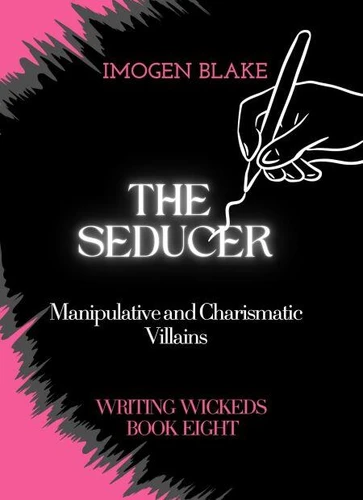
The seducer is the most acute case of the villain whose appeal has to read as appeal rather than as menace. He has to be dangerously attractive - believable as someone an intelligent adult would love - while his manipulation reads as manipulation rather than as romance. Most writers solve one demand at the expense of the other. They are the same demand seen from different angles, and the working novelist's task is to hold them together at the manuscript level. Writing Wicked: The Seducer is the working craft guide to building this character honestly.
Drawing on novels of seduction from the 1780s to the present, it covers the seducer's psychology and voice, the phases of his relationships, and the structural site of his downfall. It also does the work most guides on writing antagonists set aside: rendering manipulation as harmful without softening the villain's appeal, and addressing the romanticisation problem at the manuscript level. Inside: ·The reset move - what it is, how it operates on the protagonist, and one way to write it without naming it on the page·The construction failure that produces the unbelievable seducer, and the revision passes that fix him·The three failure modes that produce the foolish-seeming protagonist, and the specific manuscript-level fixes for each·The romanticisation problem - the ethical question at the form's centre, and the specific revision passes that work against it·Genre-specific early decisions for romance, dark romance, thriller, young adult, historical, contemporary, psychological drama, and fantasy·A complete pre-draft and revision checklist for the final manuscript passTwelve chapters with scene-level case studies, writing exercises, and a manuscript checklist. For novelists writing the villain their readers will love against their better judgment.
The book is most for the reader whose own life has been shaped by such a figure. Write for her. Writing Wicked: Book Seven.
The seducer is the most acute case of the villain whose appeal has to read as appeal rather than as menace. He has to be dangerously attractive - believable as someone an intelligent adult would love - while his manipulation reads as manipulation rather than as romance. Most writers solve one demand at the expense of the other. They are the same demand seen from different angles, and the working novelist's task is to hold them together at the manuscript level. Writing Wicked: The Seducer is the working craft guide to building this character honestly.
Drawing on novels of seduction from the 1780s to the present, it covers the seducer's psychology and voice, the phases of his relationships, and the structural site of his downfall. It also does the work most guides on writing antagonists set aside: rendering manipulation as harmful without softening the villain's appeal, and addressing the romanticisation problem at the manuscript level. Inside: ·The reset move - what it is, how it operates on the protagonist, and one way to write it without naming it on the page·The construction failure that produces the unbelievable seducer, and the revision passes that fix him·The three failure modes that produce the foolish-seeming protagonist, and the specific manuscript-level fixes for each·The romanticisation problem - the ethical question at the form's centre, and the specific revision passes that work against it·Genre-specific early decisions for romance, dark romance, thriller, young adult, historical, contemporary, psychological drama, and fantasy·A complete pre-draft and revision checklist for the final manuscript passTwelve chapters with scene-level case studies, writing exercises, and a manuscript checklist. For novelists writing the villain their readers will love against their better judgment.
The book is most for the reader whose own life has been shaped by such a figure. Write for her. Writing Wicked: Book Seven.

 , qui est-ce ?