Nouveauté
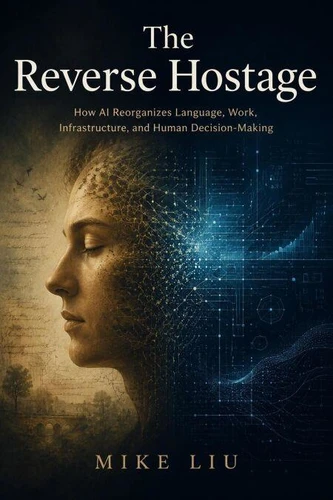
The Reverse Hostage: How AI Reorganizes Language, Work, Infrastructure, and Human Decision-Making
Par :Formats :
Disponible dans votre compte client Decitre ou Furet du Nord dès validation de votre commande. Le format ePub est :
- Compatible avec une lecture sur My Vivlio (smartphone, tablette, ordinateur)
- Compatible avec une lecture sur liseuses Vivlio
- Pour les liseuses autres que Vivlio, vous devez utiliser le logiciel Adobe Digital Edition. Non compatible avec la lecture sur les liseuses Kindle, Remarkable et Sony
 , qui est-ce ?
Notre partenaire de plateforme de lecture numérique où vous retrouverez l'ensemble de vos ebooks gratuitement
Pour en savoir plus sur nos ebooks, consultez notre aide en ligne ici
C'est si simple ! Lisez votre ebook avec l'app Vivlio sur votre tablette, mobile ou ordinateur :

- FormatePub
- ISBN978-626-93021-8-5
- EAN9786269302185
- Date de parution16/06/2026
- Protection num.pas de protection
- Infos supplémentairesepub
- ÉditeurMike's Strategic Communication
Résumé
This book examines artificial intelligence not as a tool, but as a structural layer shaping modern human systems. Most discussions about AI focus on capability, speed, or automation. This book moves beyond that framing to ask a deeper question: what happens when intelligence becomes embedded in the infrastructure of daily life. Across twelve chapters, the discussion explores how AI reshapes language, coordination, organizational structure, cognition, and system visibility.
These domains are not treated as separate technologies, but as interconnected layers of human civilization that are being gradually reconfigured. As AI systems reduce friction in communication, planning, and decision-making, they also begin to shift where cognitive effort is located. Humans increasingly move from generating structured thought to reviewing machine-generated outputs. Control does not disappear, but becomes indirect and distributed across systems that are no longer fully transparent to their users.
The central concept introduced in this book is the reverse hostage condition. It describes a system-level transformation in which human dependence on AI becomes so deeply embedded in workflows, institutions, and cognition that reversing it would require restructuring not only technology, but behavior and organizational design. This is not a warning and not an endorsement. It is an attempt to describe a transition that is already underway.
The book is written for readers who are willing to examine how agency shifts when intelligence stops being a tool and becomes an environment.
These domains are not treated as separate technologies, but as interconnected layers of human civilization that are being gradually reconfigured. As AI systems reduce friction in communication, planning, and decision-making, they also begin to shift where cognitive effort is located. Humans increasingly move from generating structured thought to reviewing machine-generated outputs. Control does not disappear, but becomes indirect and distributed across systems that are no longer fully transparent to their users.
The central concept introduced in this book is the reverse hostage condition. It describes a system-level transformation in which human dependence on AI becomes so deeply embedded in workflows, institutions, and cognition that reversing it would require restructuring not only technology, but behavior and organizational design. This is not a warning and not an endorsement. It is an attempt to describe a transition that is already underway.
The book is written for readers who are willing to examine how agency shifts when intelligence stops being a tool and becomes an environment.