Henning Börm is professor of Ancient History at the University of Rostock.
Nino Luraghi is the D. Magie Professor of Classics at Princeton University. He has published widely on ancient Greek history and historiography. His interests include tyranny and monarchy in Greece from the archaic age to the Roman conquest, ancient and modern slavery, ethnic identity and tradition, and Greek and Roman historiography and its audiences.
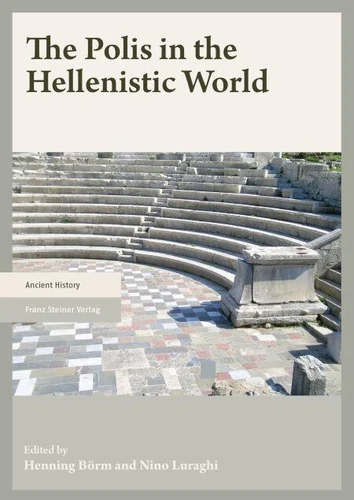
The Polis in the Hellenistic World
Par : ,Formats :
Disponible dans votre compte client Decitre ou Furet du Nord dès validation de votre commande. Le format PDF est :
- Compatible avec une lecture sur My Vivlio (smartphone, tablette, ordinateur)
- Compatible avec une lecture sur liseuses Vivlio
- Pour les liseuses autres que Vivlio, vous devez utiliser le logiciel Adobe Digital Edition. Non compatible avec la lecture sur les liseuses Kindle, Remarkable et Sony
 , qui est-ce ?
Notre partenaire de plateforme de lecture numérique où vous retrouverez l'ensemble de vos ebooks gratuitement
Pour en savoir plus sur nos ebooks, consultez notre aide en ligne ici
C'est si simple ! Lisez votre ebook avec l'app Vivlio sur votre tablette, mobile ou ordinateur :

- Nombre de pages264
- FormatPDF
- ISBN978-3-515-12027-2
- EAN9783515120272
- Date de parution18/10/2018
- Protection num.Digital Watermarking
- Taille3 Mo
- Infos supplémentairespdf
- ÉditeurFranz Steiner
Résumé
After having been for decades the province of a relatively small group of scholars, the Hellenistic polis has become central to the research agenda of Ancient historians more broadly. This development can be traced from the early nineties of the last century, and has picked up pace in a sustained fashion at the turn of the millennium. Recent research has started approaching the Greek polis of the centuries between Alexander and Cleopatra as a specific historical phenomenon, striving to define its most peculiar aspects from as many angles as possible, and to point to new avenues of interpretation that might contribute to recognizing its historical role.
In this general framework, this volume attempts to explore new lines of thought, to question established ways of reading the evidence, and to take stock of recent developments.
The contributors do not subscribe to any particular shared approach; on the contrary, their approaches and questions stem from many different scholarly traditions and methodologies. Rather than seeking to achieve a complete coverage, the volume provides a selection of current research agendas, in many cases offering glimpses of ongoing projects.
The contributors do not subscribe to any particular shared approach; on the contrary, their approaches and questions stem from many different scholarly traditions and methodologies. Rather than seeking to achieve a complete coverage, the volume provides a selection of current research agendas, in many cases offering glimpses of ongoing projects.
A propos de Henning Börm
38,99 €
31,99 €

23,99 €
73,00 €