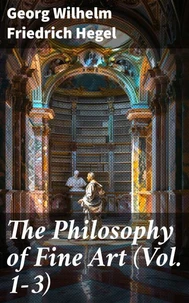
The Philosophy of Fine Art. Volume 1-3
Par : ,Formats :
Disponible dans votre compte client Decitre ou Furet du Nord dès validation de votre commande. Le format ePub est :
- Compatible avec une lecture sur My Vivlio (smartphone, tablette, ordinateur)
- Compatible avec une lecture sur liseuses Vivlio
- Pour les liseuses autres que Vivlio, vous devez utiliser le logiciel Adobe Digital Edition. Non compatible avec la lecture sur les liseuses Kindle, Remarkable et Sony
 , qui est-ce ?
Notre partenaire de plateforme de lecture numérique où vous retrouverez l'ensemble de vos ebooks gratuitement
Pour en savoir plus sur nos ebooks, consultez notre aide en ligne ici
C'est si simple ! Lisez votre ebook avec l'app Vivlio sur votre tablette, mobile ou ordinateur :

- Nombre de pages1368
- FormatePub
- ISBN859-65--4740215-2
- EAN8596547402152
- Date de parution13/11/2022
- Protection num.Digital Watermarking
- Taille2 Mo
- Infos supplémentairesepub
- ÉditeurDIGICAT
Résumé
In "The Philosophy of Fine Art, " Georg Wilhelm Friedrich Hegel offers a profound exploration of aesthetics and the nature of art within the framework of his idealist philosophy. This seminal work, published in the early 19th century, delves into the evolution of artistic expressions, examining how art embodies the unfolding of human consciousness and spirit. Hegel engages with various artistic forms-painting, sculpture, music, and poetry-analyzing their historical significance and inherent dialectical development.
His literary style intertwines rigorous philosophical inquiry with a deep appreciation for the nuances of artistic creation, situating art as a crucial component in the pursuit of absolute knowledge and self-realization. Hegel, a pivotal figure in German idealism, was heavily influenced by contemporary philosophical currents as well as the socio-political upheavals of his time. His engagement with figures like Kant and Fichte, along with the Romantic movement, helped shape his views on art as an expression of the sublime and the metaphysical.
Hegel's belief in the transformative power of art reflects his broader philosophical system, where reality is understood as a dynamic process of development and reconciliation through conflict. This book is highly recommended for those seeking a deeper understanding of art's philosophical underpinnings. Hegel's insights offer an enriching perspective not only for scholars of philosophy and aesthetics but also for artists and art enthusiasts eager to grasp the intricate connections between artistic expression and human experience.
"The Philosophy of Fine Art" is essential reading for anyone interested in the profound questions surrounding beauty, creativity, and the human condition.
His literary style intertwines rigorous philosophical inquiry with a deep appreciation for the nuances of artistic creation, situating art as a crucial component in the pursuit of absolute knowledge and self-realization. Hegel, a pivotal figure in German idealism, was heavily influenced by contemporary philosophical currents as well as the socio-political upheavals of his time. His engagement with figures like Kant and Fichte, along with the Romantic movement, helped shape his views on art as an expression of the sublime and the metaphysical.
Hegel's belief in the transformative power of art reflects his broader philosophical system, where reality is understood as a dynamic process of development and reconciliation through conflict. This book is highly recommended for those seeking a deeper understanding of art's philosophical underpinnings. Hegel's insights offer an enriching perspective not only for scholars of philosophy and aesthetics but also for artists and art enthusiasts eager to grasp the intricate connections between artistic expression and human experience.
"The Philosophy of Fine Art" is essential reading for anyone interested in the profound questions surrounding beauty, creativity, and the human condition.
A propos de Georg Wilhelm Friedrich Hegel



199,99 €

16,99 €

0,99 €