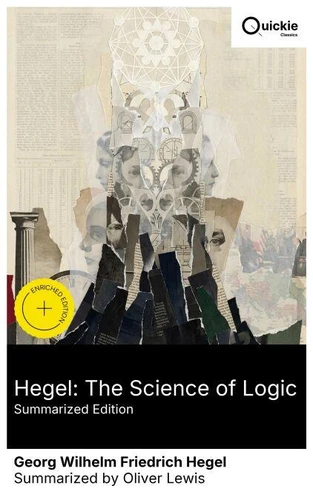
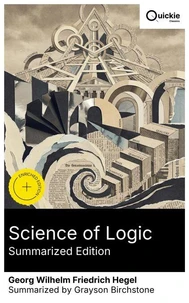
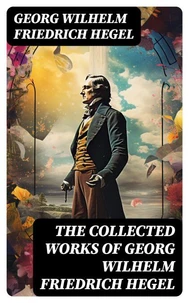
Hegel: The Science of Logic (Summarized Edition). Enriched edition. From Being–Nothing–Becoming to the self-determining Idea: determinate negation and sublation in speculative logic
Par : , ,Formats :
Disponible dans votre compte client Decitre ou Furet du Nord dès validation de votre commande. Le format ePub est :
- Compatible avec une lecture sur My Vivlio (smartphone, tablette, ordinateur)
- Compatible avec une lecture sur liseuses Vivlio
- Pour les liseuses autres que Vivlio, vous devez utiliser le logiciel Adobe Digital Edition. Non compatible avec la lecture sur les liseuses Kindle, Remarkable et Sony
 , qui est-ce ?
Notre partenaire de plateforme de lecture numérique où vous retrouverez l'ensemble de vos ebooks gratuitement
Pour en savoir plus sur nos ebooks, consultez notre aide en ligne ici
C'est si simple ! Lisez votre ebook avec l'app Vivlio sur votre tablette, mobile ou ordinateur :

- Nombre de pages143
- FormatePub
- ISBN859-65--4787705-9
- EAN8596547877059
- Date de parution10/01/2026
- Protection num.Digital Watermarking
- Taille734 Ko
- Infos supplémentairesepub
- ÉditeurQUICKIE CLASSICS
Résumé
The Science of Logic refounds logic as the self-movement of pure thought. Through the Doctrines of Being, Essence, and the Concept, Hegel tracks how indeterminate immediacy (Being-Nothing-Becoming) unfolds, by determinate negation and sublation (Aufhebung), into reflective structures and finally the self-determining Idea. Eschewing examples and formal deduction, the prose is austerely speculative: meanings emerge immanently in "speculative sentences." Within post-Kantian German Idealism, the work contests Kant's limits on metaphysics and transforms logic from a calculus of form into a science of content.
Hegel, educated at the Tübinger Stift with Hölderlin and Schelling, wrote amid the shocks of revolution and empire. The Phenomenology of Spirit supplied the standpoint; professorships at Heidelberg and Berlin shaped revisions. His aim was to reconcile modern freedom with rational necessity by exhibiting reason's own dialectical motion. Recommended to readers ready for slow, concept-by-concept study, it is indispensable for metaphysics, logic, and social theory.
Those probing the roots of Marx, phenomenology, or critical theory will find a matrix here; begin with Being's opening triad and follow each transition with care. Quickie Classics summarizes timeless works with precision, preserving the author's voice and keeping the prose clear, fast, and readable-distilled, never diluted. Enriched Edition extras: Introduction · Synopsis · Historical Context · Author Biography · Brief Analysis · 4 Reflection Q&As · Editorial Footnotes.
Hegel, educated at the Tübinger Stift with Hölderlin and Schelling, wrote amid the shocks of revolution and empire. The Phenomenology of Spirit supplied the standpoint; professorships at Heidelberg and Berlin shaped revisions. His aim was to reconcile modern freedom with rational necessity by exhibiting reason's own dialectical motion. Recommended to readers ready for slow, concept-by-concept study, it is indispensable for metaphysics, logic, and social theory.
Those probing the roots of Marx, phenomenology, or critical theory will find a matrix here; begin with Being's opening triad and follow each transition with care. Quickie Classics summarizes timeless works with precision, preserving the author's voice and keeping the prose clear, fast, and readable-distilled, never diluted. Enriched Edition extras: Introduction · Synopsis · Historical Context · Author Biography · Brief Analysis · 4 Reflection Q&As · Editorial Footnotes.
A propos de Georg Wilhelm Friedrich Hegel
199,99 €
16,99 €

0,49 €