SOLDES
Jusqu'à -70% sur une sélection d'articles*

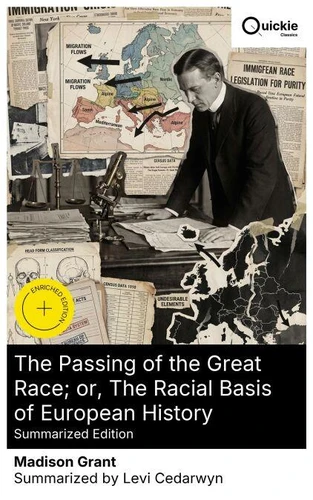
The Passing of the Great Race; or, The Racial Basis of European History (Summarized Edition). Enriched edition. Racial theory, eugenics, and the socio-political impact on European civilization
Par : ,Formats :
Disponible dans votre compte client Decitre ou Furet du Nord dès validation de votre commande. Le format ePub est :
- Compatible avec une lecture sur My Vivlio (smartphone, tablette, ordinateur)
- Compatible avec une lecture sur liseuses Vivlio
- Pour les liseuses autres que Vivlio, vous devez utiliser le logiciel Adobe Digital Edition. Non compatible avec la lecture sur les liseuses Kindle, Remarkable et Sony
 , qui est-ce ?
Notre partenaire de plateforme de lecture numérique où vous retrouverez l'ensemble de vos ebooks gratuitement
Pour en savoir plus sur nos ebooks, consultez notre aide en ligne ici
C'est si simple ! Lisez votre ebook avec l'app Vivlio sur votre tablette, mobile ou ordinateur :

- Nombre de pages73
- FormatePub
- ISBN859-65--4789231-1
- EAN8596547892311
- Date de parution03/04/2026
- Protection num.Digital Watermarking
- Taille868 Ko
- Infos supplémentairesepub
- ÉditeurQUICKIE CLASSICS
Résumé
The Passing of the Great Race (1916) advances a tripartite taxonomy of European peoples-Nordic, Alpine, Mediterranean-claiming Nordic supremacy and warning of degeneration through immigration and miscegenation. Cloaked in the rhetoric of biology, craniometry, and ethnographic maps, its brisk, declarative prose merges Progressive Era empiricism with Social Darwinist alarm. Situated amid wartime nationalism and the eugenics vogue, the book synthesizes contemporary data to mount a programmatic brief for hereditarian public policy.
Madison Grant (1865-1937), a New York lawyer, patrician conservationist, and trustee of the American Museum of Natural History, channeled the same managerial ethos that animated his wildlife preservation into human hierarchy. Allied with Henry Fairfield Osborn and Charles Davenport, and anxious about urban modernity and new immigration, he sought to stabilize an imagined Anglo-Nordic order, translating elite nativist anxieties into a putatively scientific narrative.
Readers should approach this influential yet thoroughly discredited tract as a primary source in the history of scientific racism. It illuminates the rhetorical strategies and datasets that helped shape restrictive immigration regimes, most notably the 1924 Johnson-Reed Act. Essential for scholars of race science, policy history, and environmental thought, it rewards critical reading alongside modern genetics and anthropology. Quickie Classics summarizes timeless works with precision, preserving the author's voice and keeping the prose clear, fast, and readable-distilled, never diluted.
Enriched Edition extras: Introduction · Synopsis · Historical Context · Brief Analysis · 4 Reflection Q&As · Editorial Footnotes.
Madison Grant (1865-1937), a New York lawyer, patrician conservationist, and trustee of the American Museum of Natural History, channeled the same managerial ethos that animated his wildlife preservation into human hierarchy. Allied with Henry Fairfield Osborn and Charles Davenport, and anxious about urban modernity and new immigration, he sought to stabilize an imagined Anglo-Nordic order, translating elite nativist anxieties into a putatively scientific narrative.
Readers should approach this influential yet thoroughly discredited tract as a primary source in the history of scientific racism. It illuminates the rhetorical strategies and datasets that helped shape restrictive immigration regimes, most notably the 1924 Johnson-Reed Act. Essential for scholars of race science, policy history, and environmental thought, it rewards critical reading alongside modern genetics and anthropology. Quickie Classics summarizes timeless works with precision, preserving the author's voice and keeping the prose clear, fast, and readable-distilled, never diluted.
Enriched Edition extras: Introduction · Synopsis · Historical Context · Brief Analysis · 4 Reflection Q&As · Editorial Footnotes.