SOLDES
Jusqu'à -70% sur une sélection d'articles*

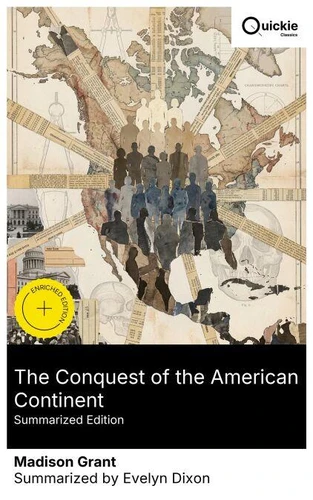
The Conquest of the American Continent (Summarized Edition). Enriched edition. European Colonization, Migration Patterns, and Power: Early America's Social Hierarchy and the Roots of Scientific Racism
Par : ,Formats :
Disponible dans votre compte client Decitre ou Furet du Nord dès validation de votre commande. Le format ePub est :
- Compatible avec une lecture sur My Vivlio (smartphone, tablette, ordinateur)
- Compatible avec une lecture sur liseuses Vivlio
- Pour les liseuses autres que Vivlio, vous devez utiliser le logiciel Adobe Digital Edition. Non compatible avec la lecture sur les liseuses Kindle, Remarkable et Sony
 , qui est-ce ?
Notre partenaire de plateforme de lecture numérique où vous retrouverez l'ensemble de vos ebooks gratuitement
Pour en savoir plus sur nos ebooks, consultez notre aide en ligne ici
C'est si simple ! Lisez votre ebook avec l'app Vivlio sur votre tablette, mobile ou ordinateur :

- Nombre de pages133
- FormatePub
- ISBN859-65--4788230-5
- EAN8596547882305
- Date de parution10/01/2026
- Protection num.Digital Watermarking
- Taille901 Ko
- Infos supplémentairesepub
- ÉditeurQUICKIE CLASSICS
Résumé
The Conquest of the American Continent (1933) presents a sweeping, polemical history of North America cast as the competitive expansion of 'races.' Mixing frontier chronicle with pseudo-scientific typologies, Madison Grant advances a Nordicist thesis that reads settlement, migration, and nation-building through hereditarian hierarchy. Written in categorical, programmatic prose, it stitches statistics, ethnological speculation, and broad generalizations into a deterministic narrative aligned with interwar eugenic discourse and nativist anxieties.
Grant, a patrician New Yorker, conservationist leader, and prominent eugenicist, had elaborated these views in The Passing of the Great Race. His stewardship of elite institutions and lobbying for immigration restriction fostered a conviction that national vitality hinged on selective heredity. Drawing on networks of racial anthropologists and policy reformers, he wrote this volume to popularize a hierarchical framework he thought should guide demographic policy.
Best approached as a revealing primary source rather than reliable history, the book suits readers of American intellectual history, immigration, and race. Recommended for those prepared to interrogate its claims alongside contemporary scholarship, it illuminates the genealogy and policy reach of scientific racism and interwar nativism. Quickie Classics summarizes timeless works with precision, preserving the author's voice and keeping the prose clear, fast, and readable-distilled, never diluted.
Enriched Edition extras: Introduction · Synopsis · Historical Context · Brief Analysis · 4 Reflection Q&As · Editorial Footnotes.
Grant, a patrician New Yorker, conservationist leader, and prominent eugenicist, had elaborated these views in The Passing of the Great Race. His stewardship of elite institutions and lobbying for immigration restriction fostered a conviction that national vitality hinged on selective heredity. Drawing on networks of racial anthropologists and policy reformers, he wrote this volume to popularize a hierarchical framework he thought should guide demographic policy.
Best approached as a revealing primary source rather than reliable history, the book suits readers of American intellectual history, immigration, and race. Recommended for those prepared to interrogate its claims alongside contemporary scholarship, it illuminates the genealogy and policy reach of scientific racism and interwar nativism. Quickie Classics summarizes timeless works with precision, preserving the author's voice and keeping the prose clear, fast, and readable-distilled, never diluted.
Enriched Edition extras: Introduction · Synopsis · Historical Context · Brief Analysis · 4 Reflection Q&As · Editorial Footnotes.