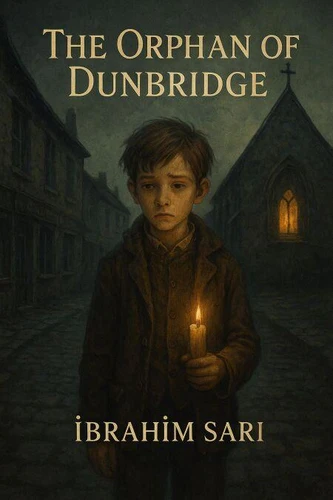
The Orphan of Dunbridge is a quiet, deeply atmospheric literary novel about a forgotten town, a boy in search of belonging, and the small miracles hidden in ordinary life. Dunbridge is not a place of heroes or legends. It is a town where lamps are trimmed, ropes keep bright ideas from running wild, and minutes are measured honestly by tides, clocks, and ribs. Its rule is written everywhere-NO THEATRE-because spectacle wastes time better spent caring for one another.
At the center of this world stands Elias Whitlock, twelve years old, orphaned, carrying nothing but a blue notebook, a burnt reader's card, and a sentence from a vicar: "Mean what you light." Apprenticed not to glory but to decency, Elias learns how names, tools, and ledgers can become acts of mercy. Through neighbors who teach him the grammar of work-Miss Price in her ledgers, Father Abel with a single candle, Kells the carpenter, Murdock the ropeman, and others-Elias discovers that belonging is built not by speeches, but by keeping minutes, returning tools, and honoring names.
A shuttered halt reopens, a library breathes again, a tide board is hung on a church porch, and a boy learns to write himself into the life of a community. This is a novel of order as care, accuracy as kindness, and time as a gift shared between neighbors. Nothing explodes, yet everything changes: a desk stops biting, a rope prevents speeches, a scarf works another season, and a town once forgotten learns to keep its minute.
Written in poetic, reflective prose, The Orphan of Dunbridge invites readers who love small-town novels, slow and thoughtful storytelling, and the quiet power of community. It is a book to be read in kettle-lengths-one chapter at a time, like the water reaching the boil. If you are seeking thunder, you may be disappointed. But if you are willing to let lamps, ledgers, and a single minute matter, you may find what Elias finds: that the opposite of being forgotten is not fame, but belonging.
The Orphan of Dunbridge is a quiet, deeply atmospheric literary novel about a forgotten town, a boy in search of belonging, and the small miracles hidden in ordinary life. Dunbridge is not a place of heroes or legends. It is a town where lamps are trimmed, ropes keep bright ideas from running wild, and minutes are measured honestly by tides, clocks, and ribs. Its rule is written everywhere-NO THEATRE-because spectacle wastes time better spent caring for one another.
At the center of this world stands Elias Whitlock, twelve years old, orphaned, carrying nothing but a blue notebook, a burnt reader's card, and a sentence from a vicar: "Mean what you light." Apprenticed not to glory but to decency, Elias learns how names, tools, and ledgers can become acts of mercy. Through neighbors who teach him the grammar of work-Miss Price in her ledgers, Father Abel with a single candle, Kells the carpenter, Murdock the ropeman, and others-Elias discovers that belonging is built not by speeches, but by keeping minutes, returning tools, and honoring names.
A shuttered halt reopens, a library breathes again, a tide board is hung on a church porch, and a boy learns to write himself into the life of a community. This is a novel of order as care, accuracy as kindness, and time as a gift shared between neighbors. Nothing explodes, yet everything changes: a desk stops biting, a rope prevents speeches, a scarf works another season, and a town once forgotten learns to keep its minute.
Written in poetic, reflective prose, The Orphan of Dunbridge invites readers who love small-town novels, slow and thoughtful storytelling, and the quiet power of community. It is a book to be read in kettle-lengths-one chapter at a time, like the water reaching the boil. If you are seeking thunder, you may be disappointed. But if you are willing to let lamps, ledgers, and a single minute matter, you may find what Elias finds: that the opposite of being forgotten is not fame, but belonging.


 , qui est-ce ?