Nouveauté
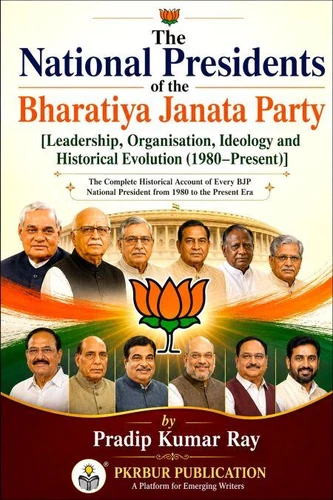
The National Presidents of the Bharatiya Janata Party [Leadership, Organisation, Ideology and Historical Evolution (1980–Present)]
Par :Formats :
Disponible dans votre compte client Decitre ou Furet du Nord dès validation de votre commande. Le format ePub est :
- Compatible avec une lecture sur My Vivlio (smartphone, tablette, ordinateur)
- Compatible avec une lecture sur liseuses Vivlio
- Pour les liseuses autres que Vivlio, vous devez utiliser le logiciel Adobe Digital Edition. Non compatible avec la lecture sur les liseuses Kindle, Remarkable et Sony
 , qui est-ce ?
Notre partenaire de plateforme de lecture numérique où vous retrouverez l'ensemble de vos ebooks gratuitement
Pour en savoir plus sur nos ebooks, consultez notre aide en ligne ici
C'est si simple ! Lisez votre ebook avec l'app Vivlio sur votre tablette, mobile ou ordinateur :

- FormatePub
- ISBN8235560758
- EAN9798235560758
- Date de parution19/07/2026
- Protection num.pas de protection
- Infos supplémentairesepub
- ÉditeurIoakim Ioakim
Résumé
The history of modern India cannot be understood without studying the evolution of its political parties. Among them, the Bharatiya Janata Party occupies a particularly significant place because of its transformation from a relatively small cadre-based organisation in 1980 into one of the most influential political parties in the world's largest democracy. Much has been written about the BJP's electoral victories, ideological positions, governments, and prominent leaders.
Comparatively less attention, however, has been devoted to the institution of the National President-the office responsible for organisational leadership, cadre mobilisation, strategic direction, membership expansion, and internal coordination. This book seeks to fill that gap. The central objective of this work is to examine the contribution of every National President of the Bharatiya Janata Party, beginning with Atal Bihari Vajpayee and continuing through the presidencies of Lal Krishna Advani, Murli Manohar Joshi, Kushabhau Thakre, Bangaru Laxman, Jana Krishnamurthi, M.
Venkaiah Naidu, Rajnath Singh, Nitin Gadkari, Amit Shah, Jagat Prakash Nadda, and Nitin Nabin. Each presidency emerged within a unique historical context. Some leaders focused on ideological consolidation, others on organisational expansion, coalition management, social outreach, electoral strategy, technological modernisation, or governance-linked political mobilisation. Together, they shaped the BJP's institutional development over more than four decades.
This book does not claim that political history can be reduced to the actions of a few individuals. Political organisations evolve through the collective efforts of thousands of workers, leaders, thinkers, and supporters. Nevertheless, the office of the National President provides an important lens through which broader organisational and political developments may be understood. Throughout this volume, an effort has been made to present historical events with fairness and balance.
Where controversies exist-whether relating to ideology, political movements, organisational decisions, or public debates-they have been discussed within their historical context. Readers may not agree with every interpretation, nor should they. The study of history thrives on informed discussion and critical engagement. Political history is never static. New evidence emerges, new perspectives develop, and future generations often reassess the significance of past events.
This book should therefore be seen not as the final word on the history of the BJP, but as a contribution to an ongoing conversation about leadership, organisation, ideology, and democratic politics in contemporary India. It is my hope that this work will assist students, researchers, political observers, journalists, and interested readers in understanding not only the leaders who occupied the office of BJP National President but also the larger historical processes through which the party evolved.
Comparatively less attention, however, has been devoted to the institution of the National President-the office responsible for organisational leadership, cadre mobilisation, strategic direction, membership expansion, and internal coordination. This book seeks to fill that gap. The central objective of this work is to examine the contribution of every National President of the Bharatiya Janata Party, beginning with Atal Bihari Vajpayee and continuing through the presidencies of Lal Krishna Advani, Murli Manohar Joshi, Kushabhau Thakre, Bangaru Laxman, Jana Krishnamurthi, M.
Venkaiah Naidu, Rajnath Singh, Nitin Gadkari, Amit Shah, Jagat Prakash Nadda, and Nitin Nabin. Each presidency emerged within a unique historical context. Some leaders focused on ideological consolidation, others on organisational expansion, coalition management, social outreach, electoral strategy, technological modernisation, or governance-linked political mobilisation. Together, they shaped the BJP's institutional development over more than four decades.
This book does not claim that political history can be reduced to the actions of a few individuals. Political organisations evolve through the collective efforts of thousands of workers, leaders, thinkers, and supporters. Nevertheless, the office of the National President provides an important lens through which broader organisational and political developments may be understood. Throughout this volume, an effort has been made to present historical events with fairness and balance.
Where controversies exist-whether relating to ideology, political movements, organisational decisions, or public debates-they have been discussed within their historical context. Readers may not agree with every interpretation, nor should they. The study of history thrives on informed discussion and critical engagement. Political history is never static. New evidence emerges, new perspectives develop, and future generations often reassess the significance of past events.
This book should therefore be seen not as the final word on the history of the BJP, but as a contribution to an ongoing conversation about leadership, organisation, ideology, and democratic politics in contemporary India. It is my hope that this work will assist students, researchers, political observers, journalists, and interested readers in understanding not only the leaders who occupied the office of BJP National President but also the larger historical processes through which the party evolved.
A propos de PRADIP KUMAR RAY
5,99 €
5,99 €

5,99 €
5,99 €

3,49 €

3,49 €


5,99 €


4,49 €