
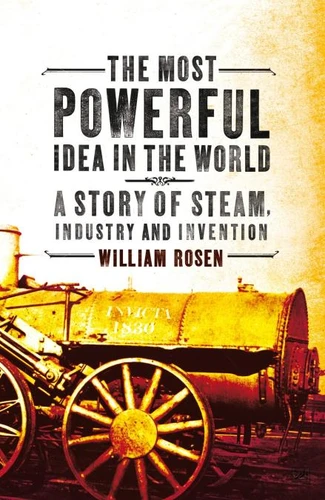
The Most Powerful Idea in the World. A Story of Steam, Industry and Invention
Par :Formats :
Disponible dans votre compte client Decitre ou Furet du Nord dès validation de votre commande. Le format ePub protégé est :
- Compatible avec une lecture sur My Vivlio (smartphone, tablette, ordinateur)
- Compatible avec une lecture sur liseuses Vivlio
- Pour les liseuses autres que Vivlio, vous devez utiliser le logiciel Adobe Digital Edition. Non compatible avec la lecture sur les liseuses Kindle, Remarkable et Sony
- Non compatible avec un achat hors France métropolitaine
 , qui est-ce ?
Notre partenaire de plateforme de lecture numérique où vous retrouverez l'ensemble de vos ebooks gratuitement
Pour en savoir plus sur nos ebooks, consultez notre aide en ligne ici
C'est si simple ! Lisez votre ebook avec l'app Vivlio sur votre tablette, mobile ou ordinateur :

- Nombre de pages400
- FormatePub
- ISBN978-1-4070-9091-7
- EAN9781407090917
- Date de parution10/06/2010
- Protection num.Adobe DRM
- Infos supplémentairesepub
- ÉditeurVintage Digital
Résumé
'The most important invention in the whole of the Industrial Revolution was invention itself.'Those words are at the heart of this remarkable book - a history of the Industrial Revolution and the steam engine, as well as an account of how inventors first came to own and profit from their ideas and how invention itself springs forth from logic and imagination. Rocket. It was the fortuitously named train that inaugurated steam locomotion in 1829, jump-starting two centuries of mass transportation.
As William Rosen reveals, it was the product of centuries of scientific and industrial discovery. From inventor Heron of Alexandria in AD 60 to James Watt, the physicist whose 'separate condenser' was central to the development of steam power - all those who made possible the long ride towards the Industrial Revolution are brought to life. But crucial to their contributions are other characters whose concepts allowed their invention to flourish - John Locke and intellectual property; Edward Coke and patents.
Along the way, Rosen takes us deep into the human mind, explaining how 'eureka' moments occur - when the brain is most relaxed.
As William Rosen reveals, it was the product of centuries of scientific and industrial discovery. From inventor Heron of Alexandria in AD 60 to James Watt, the physicist whose 'separate condenser' was central to the development of steam power - all those who made possible the long ride towards the Industrial Revolution are brought to life. But crucial to their contributions are other characters whose concepts allowed their invention to flourish - John Locke and intellectual property; Edward Coke and patents.
Along the way, Rosen takes us deep into the human mind, explaining how 'eureka' moments occur - when the brain is most relaxed.
A propos de William Rosen

Julius Caesar
E-book
6,82 €