Chris Polaris is a systems thinker, author, and clarity architect helping managers, team leads, and knowledge workers cut through cognitive drag and work with structured precision. Using frameworks like the Friction Stack, Decision Surface, and the Clarity Engine Method, he writes practical guides for professionals who want to think more clearly and work smarter - with or without AI.
Nouveauté
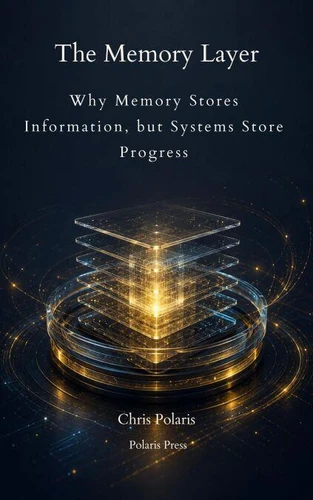
The Memory Layer
Par :Formats :
Disponible dans votre compte client Decitre ou Furet du Nord dès validation de votre commande. Le format ePub est :
- Compatible avec une lecture sur My Vivlio (smartphone, tablette, ordinateur)
- Compatible avec une lecture sur liseuses Vivlio
- Pour les liseuses autres que Vivlio, vous devez utiliser le logiciel Adobe Digital Edition. Non compatible avec la lecture sur les liseuses Kindle, Remarkable et Sony
 , qui est-ce ?
Notre partenaire de plateforme de lecture numérique où vous retrouverez l'ensemble de vos ebooks gratuitement
Pour en savoir plus sur nos ebooks, consultez notre aide en ligne ici
C'est si simple ! Lisez votre ebook avec l'app Vivlio sur votre tablette, mobile ou ordinateur :

- FormatePub
- ISBN8235655577
- EAN9798235655577
- Date de parution29/06/2026
- Protection num.pas de protection
- Infos supplémentairesepub
- ÉditeurIoakim Ioakim
Résumé
Modern work does not usually fail because people lack information. It fails because progress gets lost between sessions. The Memory Layer is a practical book about one of the most overlooked problems in modern professional work: the cost of constantly rebuilding context before work can continue. Files are stored. Notes are saved. Meetings are summarized. Messages are searchable. And yet every day, professionals return to unfinished projects and spend valuable time reconstructing what they already understood before the interruption.
This hidden cost is the Recall Tax: the cognitive effort required to rebuild context before useful work can continue. Chris Polaris explains why memory is not a work system, why information is not the same as progress, and why modern professionals and teams need a dedicated layer for preserving continuity across interruptions, transitions, decisions, and handoffs. The book introduces practical concepts such as Workflow Residue, Re-entry Cost, the Continuity Gap, Decision Latency, Shared Memory Decay, and the Progress Capture Method - a simple five-question practice for making work easier to resume.
The Memory Layer shows how individuals and teams can stop relying on human memory to carry unfinished systems and start building a clearer structure for preserving state, decisions, reasoning, open questions, and next visible steps. It is not a book about remembering more. It is a book about designing work so less has to be remembered. For professionals, managers, creators, knowledge workers, and teams using AI-assisted tools, this book offers a clear framework for reducing friction, improving continuity, and making progress compound over time.
Memory stores information. Systems store progress. Build the layer. Let the progress compound.
This hidden cost is the Recall Tax: the cognitive effort required to rebuild context before useful work can continue. Chris Polaris explains why memory is not a work system, why information is not the same as progress, and why modern professionals and teams need a dedicated layer for preserving continuity across interruptions, transitions, decisions, and handoffs. The book introduces practical concepts such as Workflow Residue, Re-entry Cost, the Continuity Gap, Decision Latency, Shared Memory Decay, and the Progress Capture Method - a simple five-question practice for making work easier to resume.
The Memory Layer shows how individuals and teams can stop relying on human memory to carry unfinished systems and start building a clearer structure for preserving state, decisions, reasoning, open questions, and next visible steps. It is not a book about remembering more. It is a book about designing work so less has to be remembered. For professionals, managers, creators, knowledge workers, and teams using AI-assisted tools, this book offers a clear framework for reducing friction, improving continuity, and making progress compound over time.
Memory stores information. Systems store progress. Build the layer. Let the progress compound.
A propos de Chris Polaris

Faster Is Not Wiser
E-book
6,49 €

AI at Home
E-book
6,99 €

The Judgment Layer
E-book
7,49 €

Thinking AI
E-book
6,49 €

The Knowledge Flow
E-book
6,99 €

Meeting AI
E-book
6,49 €

Writing AI
E-book
6,49 €
The Proof Economy
E-book
6,99 €
The Clarity Engine
E-book
6,49 €