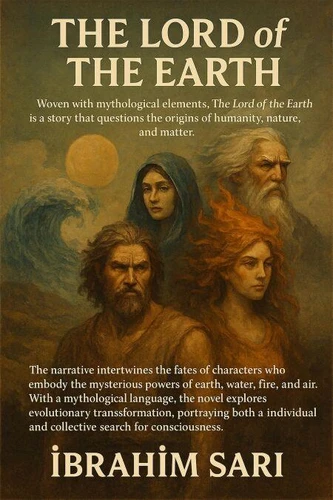
The Lord of the Earth is a lyrical novel where myth, ecology, and human responsibility converge. Written with both imagination and precision, this book blends fable with fieldwork, turning landscapes into living characters that learn, adapt, and respond to care. At the heart of the story stand four elemental guides-Arven of earth, Selora of water, Ignar of fire, and Aerya of air. They are not saviors, but habits of attention.
Through their presence, orchards learn to cast shade, culverts learn to behave like creeks, burn scars learn to hold their first rains, and entire watersheds discover the most difficult verb of all: to say we. Alongside them are local stewards-farmers, wardens, foremen, children-who already belong to the land and wish to belong to it better. Each chapter closes with an Author's Note, offering plain, practical guidance drawn from real tools, thresholds, and measures.
These notes transform the novel into a living handbook: lyrical in tone, yet precise enough to act upon. This is not a tale of heroes but of schedules, rituals, and resilience. The novel insists that resilience is found not in secrecy or spectacle, but in shared acts: hanging an amber sleeve so moths live and bats eat, brushing a leaf screen before the storm, setting drift fences so snow waits for June.
Children become crew members; neighbors become keepers of thresholds; rituals become a civic memory that outlives names. For readers who come for story, The Lord of the Earth offers owls and o-rings, dragonflies and telling-stones, mythic motifs woven with poetic detail. For those who come for practice, it offers a literature of craft-small verbs repeated until a place learns to keep its promises.
In an age of long emergencies and short attention, this novel offers a quiet faith: that places remember kindness, that stewardship is contagious, and that together we can learn the grammar of resilience.
The Lord of the Earth is a lyrical novel where myth, ecology, and human responsibility converge. Written with both imagination and precision, this book blends fable with fieldwork, turning landscapes into living characters that learn, adapt, and respond to care. At the heart of the story stand four elemental guides-Arven of earth, Selora of water, Ignar of fire, and Aerya of air. They are not saviors, but habits of attention.
Through their presence, orchards learn to cast shade, culverts learn to behave like creeks, burn scars learn to hold their first rains, and entire watersheds discover the most difficult verb of all: to say we. Alongside them are local stewards-farmers, wardens, foremen, children-who already belong to the land and wish to belong to it better. Each chapter closes with an Author's Note, offering plain, practical guidance drawn from real tools, thresholds, and measures.
These notes transform the novel into a living handbook: lyrical in tone, yet precise enough to act upon. This is not a tale of heroes but of schedules, rituals, and resilience. The novel insists that resilience is found not in secrecy or spectacle, but in shared acts: hanging an amber sleeve so moths live and bats eat, brushing a leaf screen before the storm, setting drift fences so snow waits for June.
Children become crew members; neighbors become keepers of thresholds; rituals become a civic memory that outlives names. For readers who come for story, The Lord of the Earth offers owls and o-rings, dragonflies and telling-stones, mythic motifs woven with poetic detail. For those who come for practice, it offers a literature of craft-small verbs repeated until a place learns to keep its promises.
In an age of long emergencies and short attention, this novel offers a quiet faith: that places remember kindness, that stewardship is contagious, and that together we can learn the grammar of resilience.

 , qui est-ce ?