Nouveauté
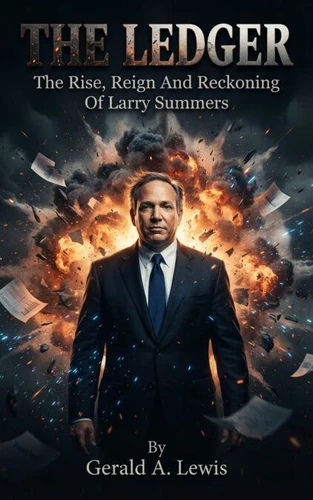
THE LEDGER. The Rise, Reign, and Reckoning of Larry Summers
Par :Formats :
Disponible dans votre compte client Decitre ou Furet du Nord dès validation de votre commande. Le format ePub est :
- Compatible avec une lecture sur My Vivlio (smartphone, tablette, ordinateur)
- Compatible avec une lecture sur liseuses Vivlio
- Pour les liseuses autres que Vivlio, vous devez utiliser le logiciel Adobe Digital Edition. Non compatible avec la lecture sur les liseuses Kindle, Remarkable et Sony
 , qui est-ce ?
Notre partenaire de plateforme de lecture numérique où vous retrouverez l'ensemble de vos ebooks gratuitement
Pour en savoir plus sur nos ebooks, consultez notre aide en ligne ici
C'est si simple ! Lisez votre ebook avec l'app Vivlio sur votre tablette, mobile ou ordinateur :

- Nombre de pages110
- FormatePub
- ISBN8259615625
- EAN9798259615625
- Date de parution04/08/2026
- Protection num.pas de protection
- Taille604 Ko
- Infos supplémentairesepub
- ÉditeurChiify
Résumé
Description ????
For fifty years, Lawrence Summers was one of the most trusted minds in American public life - and one of the most self-destructive. THE LEDGER is the first complete account of how a single trait, unwavering confidence in his own judgment, built one of the most consequential careers in modern American economics and then, decade after decade, tore pieces of it back down.
He was tenured at Harvard at twenty-eight.
He won the John Bates Clark Medal before he turned forty. He helped rescue Mexico, Asia, and Russia from financial collapse as part of a team Time magazine famously dubbed "The Committee to Save the World." He became the youngest Treasury Secretary in nearly two centuries, then the president of Harvard University, then the man Barack Obama trusted to steer the country through its worst financial crisis since the Depression.
Along the way, he also signed a memo proposing that pollution be shipped to poor countries because the economics were "impeccable." He dismissed one of Harvard's most distinguished professors in a meeting colleague called a disaster. He suggested, at a national conference, that biology might explain why women were scarce in science - and lost his presidency for it within the year. And in a final reckoning that unfolded as this book went to press, a trove of private correspondence with a convicted sex offender cost him nearly every institution he had left. THE LEDGER follows this single thread across five decades and two continents of crisis management: a mind built from childhood to trust its own conclusions, operating inside institutions that eventually asked it to be something else.
Drawing entirely on congressional testimony, Treasury and World Bank records, Harvard's own institutional archive, and three decades of contemporaneous reporting, this unauthorized biography reconstructs both sides of an extraordinary ledger - the budget surpluses and the deregulation that helped cause a global crisis; the financial aid reform that changed American higher education and the faculty revolt that ended a presidency; the economic warnings that proved prophetic and the private judgments that proved catastrophic. This is not a hagiography, and it is not a takedown.
It is a narrative reconstruction, in the tradition of Walter Isaacson and Doris Kearns Goodwin, of what happens when brilliance and self-destruction come from exactly the same source. Every chapter is built from the public record, with contested episodes presented as contested rather than resolved by authorial fiat, and with the book's final chapters - written as events were still unfolding in early 2026 - held to the same evidentiary standard as its account of 1991. Readers of Ron Suskind's Confidence Men and Andrew Ross Sorkin's Too Big to Fail will recognize the terrain.
But this is not primarily a book about markets - it is a book about a man who spent his life being right in rooms that eventually stopped forgiving him for it, and what a career this is consequential, and this compromised, actually adds up to. Inside you'll find: The 1991 World Bank memo that haunted three decades of confirmation hearings The inside story of the Mexican peso rescue and the "Committee to Save the World" The Harvard presidency: the financial aid revolution, the Cornel West conflict, and the faculty vote that ended it Two years inside Obama's Situation Room during the fight over the size of the stimulus The Wall Street years, the disclosure forms, and the questions they raised Two prophetic economic calls, a decade apart, that.
He won the John Bates Clark Medal before he turned forty. He helped rescue Mexico, Asia, and Russia from financial collapse as part of a team Time magazine famously dubbed "The Committee to Save the World." He became the youngest Treasury Secretary in nearly two centuries, then the president of Harvard University, then the man Barack Obama trusted to steer the country through its worst financial crisis since the Depression.
Along the way, he also signed a memo proposing that pollution be shipped to poor countries because the economics were "impeccable." He dismissed one of Harvard's most distinguished professors in a meeting colleague called a disaster. He suggested, at a national conference, that biology might explain why women were scarce in science - and lost his presidency for it within the year. And in a final reckoning that unfolded as this book went to press, a trove of private correspondence with a convicted sex offender cost him nearly every institution he had left. THE LEDGER follows this single thread across five decades and two continents of crisis management: a mind built from childhood to trust its own conclusions, operating inside institutions that eventually asked it to be something else.
Drawing entirely on congressional testimony, Treasury and World Bank records, Harvard's own institutional archive, and three decades of contemporaneous reporting, this unauthorized biography reconstructs both sides of an extraordinary ledger - the budget surpluses and the deregulation that helped cause a global crisis; the financial aid reform that changed American higher education and the faculty revolt that ended a presidency; the economic warnings that proved prophetic and the private judgments that proved catastrophic. This is not a hagiography, and it is not a takedown.
It is a narrative reconstruction, in the tradition of Walter Isaacson and Doris Kearns Goodwin, of what happens when brilliance and self-destruction come from exactly the same source. Every chapter is built from the public record, with contested episodes presented as contested rather than resolved by authorial fiat, and with the book's final chapters - written as events were still unfolding in early 2026 - held to the same evidentiary standard as its account of 1991. Readers of Ron Suskind's Confidence Men and Andrew Ross Sorkin's Too Big to Fail will recognize the terrain.
But this is not primarily a book about markets - it is a book about a man who spent his life being right in rooms that eventually stopped forgiving him for it, and what a career this is consequential, and this compromised, actually adds up to. Inside you'll find: The 1991 World Bank memo that haunted three decades of confirmation hearings The inside story of the Mexican peso rescue and the "Committee to Save the World" The Harvard presidency: the financial aid revolution, the Cornel West conflict, and the faculty vote that ended it Two years inside Obama's Situation Room during the fight over the size of the stimulus The Wall Street years, the disclosure forms, and the questions they raised Two prophetic economic calls, a decade apart, that.
A propos de Gerald A. Lewis


5,99 €