Nouveauté
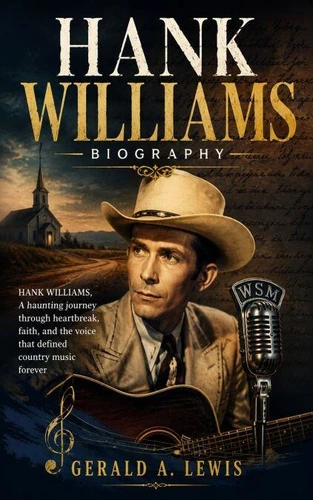
HANK WILLIAMS BIOGRAPHY. The Legend Who Sang His Soul Away
Par :Formats :
Disponible dans votre compte client Decitre ou Furet du Nord dès validation de votre commande. Le format ePub est :
- Compatible avec une lecture sur My Vivlio (smartphone, tablette, ordinateur)
- Compatible avec une lecture sur liseuses Vivlio
- Pour les liseuses autres que Vivlio, vous devez utiliser le logiciel Adobe Digital Edition. Non compatible avec la lecture sur les liseuses Kindle, Remarkable et Sony
 , qui est-ce ?
Notre partenaire de plateforme de lecture numérique où vous retrouverez l'ensemble de vos ebooks gratuitement
Pour en savoir plus sur nos ebooks, consultez notre aide en ligne ici
C'est si simple ! Lisez votre ebook avec l'app Vivlio sur votre tablette, mobile ou ordinateur :

- Nombre de pages200
- FormatePub
- ISBN8259606395
- EAN9798259606395
- Date de parution21/07/2026
- Protection num.pas de protection
- Taille963 Ko
- Infos supplémentairesepub
- ÉditeurChiify
Résumé
Hank Williams: The Legend Who Sang His Soul Away
A Haunting Journey Through Heartbreak, Faith, and the Voice That Defined Country Music Forever
Before there was outlaw country, before Nashville became an industry, there was a lanky, hollow-eyed boy from Mount Olive, Alabama, who turned pain into poetry and heartbreak into hymns. Hank Williams didn't just sing country music - he became it. In a career that lasted barely six years, he wrote the blueprint for every heartbroken ballad, every lonesome highway song, every three-chord confession that followed him.
This is the story of a man torn between two worlds: the God-fearing boy raised on gospel harmonies in a clapboard church, and the whiskey-soaked wanderer who chased oblivion down empty highways.
Born with a spine crippled by undiagnosed spina bifida, Hank grew up in pain that never left him - pain that would later fuel both his music and his addictions. He taught himself guitar from a Black street musician named Rufus "Tee-Tot" Payne, an artistic debt Hank never denied and rarely got credit for sharing. By the time he stepped onto the stage of the Grand Ole Opry in 1949, he was already a phenomenon - a voice that cracked with such raw, aching honesty that audiences didn't just listen, they felt.
"Lovesick Blues, " "Cold, Cold Heart, " "I'm So Lonesome I Could Cry, " "Your Cheatin' Heart" - these weren't just hit songs. They were confessions set to melody, diary entries from a man who wore his wounds in public and somehow made millions feel less alone in theirs. But behind the rhinestone suits and the Cadillac was a man unraveling. A tumultuous marriage to Audrey Williams that inspired both his greatest songs and his deepest despair.
A body wracked with chronic back pain, treated with a reckless cocktail of alcohol and morphine that spiraled into addiction. A career that rocketed to stardom even as the man living it slipped further from the spotlight's warmth into private torment. This biography traces every mile of that short, blazing arc - from the dirt roads of rural Alabama to the bright lights of Nashville, from the church pews where he first learned to harmonize to the smoky honky-tonks where he learned to bleed for an audience.
It explores his complicated faith, forever present in songs like "I Saw the Light, " even as his own life seemed to drift further into darkness. It examines his creative partnership with Fred Rose, the Nashville machine that built him into a star, and the fractures - professional, marital, physical - that slowly pulled him apart. And it arrives, unflinchingly, at the end: New Year's Eve, 1952, a Cadillac speeding through the night toward a show he'd never reach, a twenty-nine-year-old body finally giving out under the weight of everything it had carried.
Hank Williams died before he could vote for himself as a legend, but the world had already decided. In the decades since, his songs have never stopped playing - covered, sampled, mourned, and revered by every generation of musician who understood that country music, at its core, is about telling the truth even when it hurts. This is more than a music biography. It's a portrait of American loneliness, of genius entangled with self-destruction, and of a voice so plainly, achingly human that it still reaches across seventy years to remind us: some hearts break so beautifully that the whole world stops to listen. --- Want me to adjust the tone (more literary vs.
more commercial/marketing-style), shorten it further, or format it as an actual book-jacket layout?
Born with a spine crippled by undiagnosed spina bifida, Hank grew up in pain that never left him - pain that would later fuel both his music and his addictions. He taught himself guitar from a Black street musician named Rufus "Tee-Tot" Payne, an artistic debt Hank never denied and rarely got credit for sharing. By the time he stepped onto the stage of the Grand Ole Opry in 1949, he was already a phenomenon - a voice that cracked with such raw, aching honesty that audiences didn't just listen, they felt.
"Lovesick Blues, " "Cold, Cold Heart, " "I'm So Lonesome I Could Cry, " "Your Cheatin' Heart" - these weren't just hit songs. They were confessions set to melody, diary entries from a man who wore his wounds in public and somehow made millions feel less alone in theirs. But behind the rhinestone suits and the Cadillac was a man unraveling. A tumultuous marriage to Audrey Williams that inspired both his greatest songs and his deepest despair.
A body wracked with chronic back pain, treated with a reckless cocktail of alcohol and morphine that spiraled into addiction. A career that rocketed to stardom even as the man living it slipped further from the spotlight's warmth into private torment. This biography traces every mile of that short, blazing arc - from the dirt roads of rural Alabama to the bright lights of Nashville, from the church pews where he first learned to harmonize to the smoky honky-tonks where he learned to bleed for an audience.
It explores his complicated faith, forever present in songs like "I Saw the Light, " even as his own life seemed to drift further into darkness. It examines his creative partnership with Fred Rose, the Nashville machine that built him into a star, and the fractures - professional, marital, physical - that slowly pulled him apart. And it arrives, unflinchingly, at the end: New Year's Eve, 1952, a Cadillac speeding through the night toward a show he'd never reach, a twenty-nine-year-old body finally giving out under the weight of everything it had carried.
Hank Williams died before he could vote for himself as a legend, but the world had already decided. In the decades since, his songs have never stopped playing - covered, sampled, mourned, and revered by every generation of musician who understood that country music, at its core, is about telling the truth even when it hurts. This is more than a music biography. It's a portrait of American loneliness, of genius entangled with self-destruction, and of a voice so plainly, achingly human that it still reaches across seventy years to remind us: some hearts break so beautifully that the whole world stops to listen. --- Want me to adjust the tone (more literary vs.
more commercial/marketing-style), shorten it further, or format it as an actual book-jacket layout?
A propos de Gerald A. Lewis



5,99 €