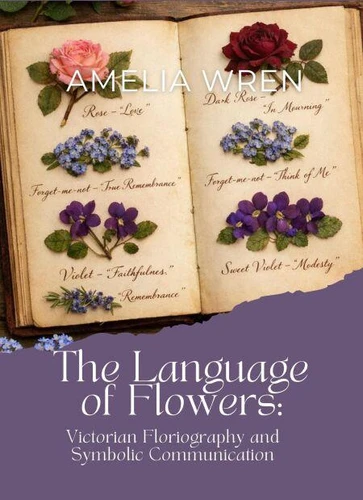
When a Victorian woman received a small bouquet of red roses, forget-me-nots, and rosemary, she did not simply see flowers. She read a message: passionate love, the promise of remembrance, the declaration of fidelity. For much of the nineteenth century, flowers were a language, and the men and women who spoke it could conduct entire conversations in petals and stems, saying with a carefully composed posy what the age would not permit them to say aloud. The Language of Flowers traces this remarkable tradition from its origins in the Ottoman practice of selam through its flowering in Victorian England, where it produced an extraordinary culture of flower dictionaries, symbolic gardens, tussie-mussies, and pressed flower albums.
At its heart, the book argues that the flower language endures because it is grounded in the natural world's own expressive qualities: the red rose does not merely represent love, it embodies it, and the forget-me-not does not merely symbolize remembrance, it enacts it. Today, a growing community of practitioners is rediscovering in the flower language something that the modern world rarely provides: a form of communication that is precise, beautiful, and rooted in the living world.
This book is your guide to joining them.
When a Victorian woman received a small bouquet of red roses, forget-me-nots, and rosemary, she did not simply see flowers. She read a message: passionate love, the promise of remembrance, the declaration of fidelity. For much of the nineteenth century, flowers were a language, and the men and women who spoke it could conduct entire conversations in petals and stems, saying with a carefully composed posy what the age would not permit them to say aloud. The Language of Flowers traces this remarkable tradition from its origins in the Ottoman practice of selam through its flowering in Victorian England, where it produced an extraordinary culture of flower dictionaries, symbolic gardens, tussie-mussies, and pressed flower albums.
At its heart, the book argues that the flower language endures because it is grounded in the natural world's own expressive qualities: the red rose does not merely represent love, it embodies it, and the forget-me-not does not merely symbolize remembrance, it enacts it. Today, a growing community of practitioners is rediscovering in the flower language something that the modern world rarely provides: a form of communication that is precise, beautiful, and rooted in the living world.
This book is your guide to joining them.

 , qui est-ce ?