
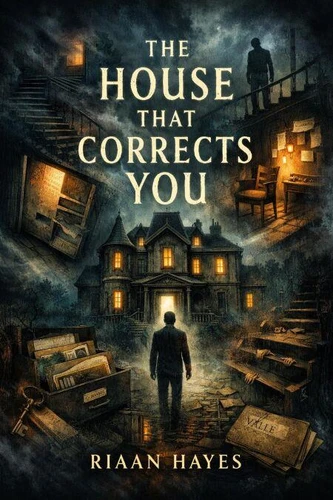
The House that Corrects You
Par :Formats :
Disponible dans votre compte client Decitre ou Furet du Nord dès validation de votre commande. Le format ePub est :
- Compatible avec une lecture sur My Vivlio (smartphone, tablette, ordinateur)
- Compatible avec une lecture sur liseuses Vivlio
- Pour les liseuses autres que Vivlio, vous devez utiliser le logiciel Adobe Digital Edition. Non compatible avec la lecture sur les liseuses Kindle, Remarkable et Sony
 , qui est-ce ?
Notre partenaire de plateforme de lecture numérique où vous retrouverez l'ensemble de vos ebooks gratuitement
Pour en savoir plus sur nos ebooks, consultez notre aide en ligne ici
C'est si simple ! Lisez votre ebook avec l'app Vivlio sur votre tablette, mobile ou ordinateur :

- FormatePub
- ISBN8233098673
- EAN9798233098673
- Date de parution20/03/2026
- Protection num.pas de protection
- Infos supplémentairesepub
- ÉditeurLinda Balsamo
Résumé
The House That Corrects Youby Riaan HayesWhen Elias Vale receives a letter that has already been opened, he expects a mistake. Instead, he receives an instruction. The house is yours now. Do not begin with the upper rooms. You were expected yesterday. The message leads him to Larkhill House, a silent estate at the edge of a forgotten village, where doors do not simply open and rooms do not behave like rooms.
Inside, a register has already recorded his arrival. A file appears containing photographs that suggest he has been there before. Somewhere above him, another version of his voice speaks from the staircase. Somewhere below the floor, something begins to knock. What Elias slowly discovers is that Larkhill House was never meant to be a home. It was built for a very different purpose. People once came to this house to be told which version of themselves had arrived.
Not who they believed they were. Not who they hoped to become. But the account of themselves the world could continue. Each room in the house reveals another correction. Each corridor opens into another contradiction of time, memory, and identity. Some rooms ask questions. Some contain records. Others hold evidence that events have already happened-or will happen-depending on who is reading the story.
The deeper Elias goes, the more he realizes that the house does not merely contain mystery. It performs it. It examines. It measures. It decides. As Elias moves deeper into Larkhill House, he begins to understand that identity is not treated there as a single truth. It is treated as competing accounts. Versions of a life. Interpretations that can replace each other if the wrong one becomes official.
In this house, delay creates vacancy, and vacancy invites substitution. If a person cannot contradict the false version in time, the false version may continue in their place. And the house has already begun deciding which version of Elias will remain. The House That Corrects You is not a conventional mystery or thriller. It is a psychological and philosophical novel about identity, memory, survival, and the dangerous stories people learn to live inside.
The architecture of the house reflects the architecture of the mind. Rooms behave like questions. Files behave like memory. Corridors behave like revisions. And time moves less like a straight line than like a record being rewritten by competing hands. Readers should approach this book with patience, alertness, and curiosity. It is intentionally layered, literary, and at times disorienting. Certain scenes may not fully make sense at first, and meanings often change as the story progresses.
What appears confusing in one chapter may become clear many chapters later. What seems symbolic may turn literal. What seems literal may later reveal itself as a wound, a correction, or a test. That is not a flaw in the reading experience. It is part of the design. This is a book for readers who enjoy being drawn into a world that must be interpreted slowly. It rewards attention, reflection, and rereading.
It does not ask the reader to consume the story quickly. It asks the reader to enter it carefully. The novel's intent is not only to tell a story, but to make the reader feel what it means to move through uncertainty, misreading, and the frightening instability of selfhood. For readers who love psychological mystery, literary horror, and intellectually immersive fiction, this novel offers a haunting experience where atmosphere, structure, and meaning are bound tightly together.
In this house, the wrong door is never just a door. The wrong memory is never just a mistake. And the wrong version of a life can become the official one if no one is left to contradict it. Some houses keep secrets. This one keeps accounts
Inside, a register has already recorded his arrival. A file appears containing photographs that suggest he has been there before. Somewhere above him, another version of his voice speaks from the staircase. Somewhere below the floor, something begins to knock. What Elias slowly discovers is that Larkhill House was never meant to be a home. It was built for a very different purpose. People once came to this house to be told which version of themselves had arrived.
Not who they believed they were. Not who they hoped to become. But the account of themselves the world could continue. Each room in the house reveals another correction. Each corridor opens into another contradiction of time, memory, and identity. Some rooms ask questions. Some contain records. Others hold evidence that events have already happened-or will happen-depending on who is reading the story.
The deeper Elias goes, the more he realizes that the house does not merely contain mystery. It performs it. It examines. It measures. It decides. As Elias moves deeper into Larkhill House, he begins to understand that identity is not treated there as a single truth. It is treated as competing accounts. Versions of a life. Interpretations that can replace each other if the wrong one becomes official.
In this house, delay creates vacancy, and vacancy invites substitution. If a person cannot contradict the false version in time, the false version may continue in their place. And the house has already begun deciding which version of Elias will remain. The House That Corrects You is not a conventional mystery or thriller. It is a psychological and philosophical novel about identity, memory, survival, and the dangerous stories people learn to live inside.
The architecture of the house reflects the architecture of the mind. Rooms behave like questions. Files behave like memory. Corridors behave like revisions. And time moves less like a straight line than like a record being rewritten by competing hands. Readers should approach this book with patience, alertness, and curiosity. It is intentionally layered, literary, and at times disorienting. Certain scenes may not fully make sense at first, and meanings often change as the story progresses.
What appears confusing in one chapter may become clear many chapters later. What seems symbolic may turn literal. What seems literal may later reveal itself as a wound, a correction, or a test. That is not a flaw in the reading experience. It is part of the design. This is a book for readers who enjoy being drawn into a world that must be interpreted slowly. It rewards attention, reflection, and rereading.
It does not ask the reader to consume the story quickly. It asks the reader to enter it carefully. The novel's intent is not only to tell a story, but to make the reader feel what it means to move through uncertainty, misreading, and the frightening instability of selfhood. For readers who love psychological mystery, literary horror, and intellectually immersive fiction, this novel offers a haunting experience where atmosphere, structure, and meaning are bound tightly together.
In this house, the wrong door is never just a door. The wrong memory is never just a mistake. And the wrong version of a life can become the official one if no one is left to contradict it. Some houses keep secrets. This one keeps accounts
A propos de Riaan Hayes
4,49 €
4,49 €
4,49 €
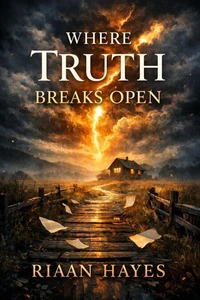
Where Truth Breaks Open
E-book
4,49 €
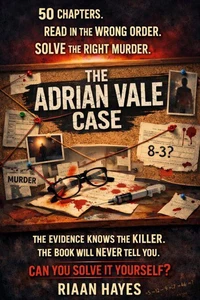
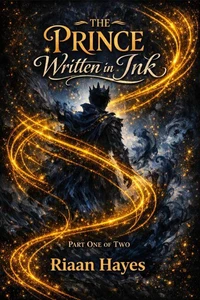
4,49 €
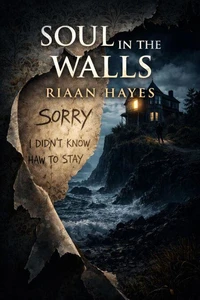
Soul in the Walls
E-book
5,49 €
Shadowseeker
E-book
4,49 €