Dernière sortie
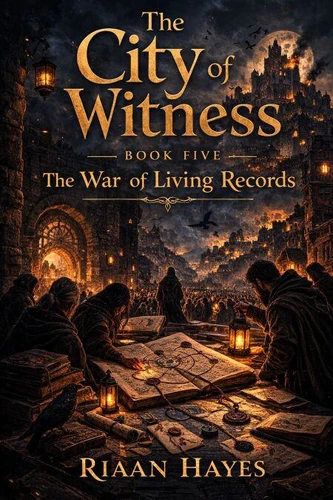
The War of Living Records
In The City of Witness: Book Five - The War of Living Records, Oakhaven reaches the moment everything in the series has been moving toward. The city has already survived buried truths, erased kings, hidden rooms, false histories, and the slow violence of controlled memory. Now the final battle is no longer only about who once had the right to rule. It is about something far more dangerous: who has the right to name truth when witness itself has been broken.
When the Crown begins seizing copies, records, and family-held fragments, it believes it can win by controlling custody. But the city answers with a terrifying realization: if the copies can be taken, then the city itself must become the record. What follows is not a conventional rebellion, but the awakening of a living civic body. House by house, district by district, women, workers, widows, burial keepers, children, grain carriers, wash women, and hidden route-runners begin carrying truth in memory, labor, sequence, and speech.
The city learns to survive not through one chosen hero, but through a distributed system of hearing, refusal, correction, and shared witness. As the hidden archive beneath custody is uncovered, devastating truths rise into the light. The old order was never lawful in the way the Crown claimed. Naming was supposed to come only after hearing, and hearing only after the room itself had borne witness.
But the witness office was broken. The crime at the heart of Oakhaven was not only murder or usurpation. It was the theft of lawful sequence. Since then, the kingdom has lived under crowns that stood above witness instead of beneath it. Book Five follows Lucen, Selyn, Elara, Mara, Vedra, Rhess, and the city itself as they fight a war not only against soldiers and officials, but against delay, confiscation, false comfort, administrative lies, and the seductive promise of easier order.
The Crown tries everything: custody, review, temporary authority, silence, bans on hearing, listeners, carrying laws, direct searches, and the criminalizing of neighborly care. But every move teaches the city more clearly what power fears most: not noise, but lawful public hearing that cannot be contained in one chamber, one office, one king, or one witness-body. At the heart of the novel is one of the series' deepest revelations: witness cannot return in one body.
The city must learn to witness itself before it names anything. That truth transforms the final conflict. Oakhaven refuses the old fantasy of rescue by one rightful ruler. Instead, it fights toward a harder hope - a civic order in which room, hearing, refusal, carrying, and memory stand around the broken place lawfully enough that naming no longer becomes theft. Dark, political, emotionally charged, and rich with layered civic tension, The War of Living Records is the explosive conclusion to a five-book epic about truth, power, memory, and the cost of lawful witness.
It is a final book about a city that refuses to be named over, a people who become more difficult to erase each time power strikes them, and an ending that does not simply restore a throne, but remakes the meaning of authority itself. In Oakhaven, the final victory is not that the city finds a king. It is that the city becomes lawful enough to decide what no crown may ever stand above again. The novel blends political fantasy with intimate human cost.
Every victory is paid for through ordinary bodies: children taught the wrong answers first so the true line can survive, women hiding records in cloth and work routines, burial rooms preserving refusal, and exhausted districts learning that carrying one another is not weakness but law. The result is a finale that feels both epic and deeply personal. Rather than ending with easy restoration, it ends with the city facing the hardest possible question: what kind of authority can exist after truth has been betrayed for generations?
When the Crown begins seizing copies, records, and family-held fragments, it believes it can win by controlling custody. But the city answers with a terrifying realization: if the copies can be taken, then the city itself must become the record. What follows is not a conventional rebellion, but the awakening of a living civic body. House by house, district by district, women, workers, widows, burial keepers, children, grain carriers, wash women, and hidden route-runners begin carrying truth in memory, labor, sequence, and speech.
The city learns to survive not through one chosen hero, but through a distributed system of hearing, refusal, correction, and shared witness. As the hidden archive beneath custody is uncovered, devastating truths rise into the light. The old order was never lawful in the way the Crown claimed. Naming was supposed to come only after hearing, and hearing only after the room itself had borne witness.
But the witness office was broken. The crime at the heart of Oakhaven was not only murder or usurpation. It was the theft of lawful sequence. Since then, the kingdom has lived under crowns that stood above witness instead of beneath it. Book Five follows Lucen, Selyn, Elara, Mara, Vedra, Rhess, and the city itself as they fight a war not only against soldiers and officials, but against delay, confiscation, false comfort, administrative lies, and the seductive promise of easier order.
The Crown tries everything: custody, review, temporary authority, silence, bans on hearing, listeners, carrying laws, direct searches, and the criminalizing of neighborly care. But every move teaches the city more clearly what power fears most: not noise, but lawful public hearing that cannot be contained in one chamber, one office, one king, or one witness-body. At the heart of the novel is one of the series' deepest revelations: witness cannot return in one body.
The city must learn to witness itself before it names anything. That truth transforms the final conflict. Oakhaven refuses the old fantasy of rescue by one rightful ruler. Instead, it fights toward a harder hope - a civic order in which room, hearing, refusal, carrying, and memory stand around the broken place lawfully enough that naming no longer becomes theft. Dark, political, emotionally charged, and rich with layered civic tension, The War of Living Records is the explosive conclusion to a five-book epic about truth, power, memory, and the cost of lawful witness.
It is a final book about a city that refuses to be named over, a people who become more difficult to erase each time power strikes them, and an ending that does not simply restore a throne, but remakes the meaning of authority itself. In Oakhaven, the final victory is not that the city finds a king. It is that the city becomes lawful enough to decide what no crown may ever stand above again. The novel blends political fantasy with intimate human cost.
Every victory is paid for through ordinary bodies: children taught the wrong answers first so the true line can survive, women hiding records in cloth and work routines, burial rooms preserving refusal, and exhausted districts learning that carrying one another is not weakness but law. The result is a finale that feels both epic and deeply personal. Rather than ending with easy restoration, it ends with the city facing the hardest possible question: what kind of authority can exist after truth has been betrayed for generations?
Les livres de Riaan Hayes
4,49 €
4,49 €
4,49 €
4,49 €

Where Truth Breaks Open
E-book
4,49 €


4,49 €
Soul in the Walls
E-book
5,49 €
Shadowseeker
E-book
4,49 €