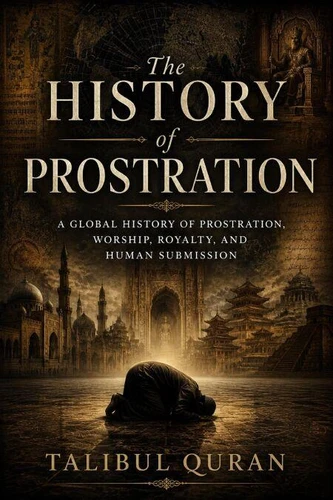
Why do human beings bow, kneel, or place their foreheads upon the ground?Across civilizations, prostration has expressed some of humanity's most powerful emotions and relationships. It has been used to worship God, honor rulers, greet elders, seek forgiveness, demonstrate loyalty, accept defeat, and impose humiliation. Yet the same physical posture can carry radically different meanings depending on who performs it, who receives it, and whether it is freely chosen.
In The History of Prostration, Talibul Quran presents a wide-ranging global study of the lowered human body. Moving from the royal courts of Mesopotamia, Egypt, Persia, Greece, Rome, and Byzantium to the religious traditions of Judaism, Christianity, Islam, Hinduism, Buddhism, Jainism, and Sikhism, this book examines how bodily gestures became visible expressions of faith, authority, social rank, repentance, and submission.
The book explores:. Prostration before deities, sacred objects, monarchs, teachers, parents, and elders. The Islamic theology of sujud and the exclusive worship of Allah. Biblical accounts of bowing before God, prophets, rulers, and family members. Christian kneeling, genuflection, monastic prostration, and the veneration of sacred objects. Hindu, Buddhist, Jain, and Sikh traditions of reverence and humility.
The Persian proskynesis controversy and Alexander the Great. The Chinese kowtow, Japanese bowing, Korean ceremonial gestures, and Southeast Asian court etiquette. African customs of prostration, kneeling, kingship, and respect for elders. Royal protocol, diplomatic disputes, public apologies, political submission, and resistance. The difference between voluntary humility and forced humiliationRather than assuming that every bowed body represents worship-or that ritual gestures are meaningless customs-Talibul Quran asks readers to consider posture, intention, recipient, theology, culture, and power.
The History of Prostration reveals that bodily submission can represent both the surrender of human freedom and the believer's highest expression of devotion. It is a compelling work of comparative religious history, cultural anthropology, and political analysis that challenges readers to look more carefully at one of humanity's oldest and most misunderstood gestures.
Why do human beings bow, kneel, or place their foreheads upon the ground?Across civilizations, prostration has expressed some of humanity's most powerful emotions and relationships. It has been used to worship God, honor rulers, greet elders, seek forgiveness, demonstrate loyalty, accept defeat, and impose humiliation. Yet the same physical posture can carry radically different meanings depending on who performs it, who receives it, and whether it is freely chosen.
In The History of Prostration, Talibul Quran presents a wide-ranging global study of the lowered human body. Moving from the royal courts of Mesopotamia, Egypt, Persia, Greece, Rome, and Byzantium to the religious traditions of Judaism, Christianity, Islam, Hinduism, Buddhism, Jainism, and Sikhism, this book examines how bodily gestures became visible expressions of faith, authority, social rank, repentance, and submission.
The book explores:. Prostration before deities, sacred objects, monarchs, teachers, parents, and elders. The Islamic theology of sujud and the exclusive worship of Allah. Biblical accounts of bowing before God, prophets, rulers, and family members. Christian kneeling, genuflection, monastic prostration, and the veneration of sacred objects. Hindu, Buddhist, Jain, and Sikh traditions of reverence and humility.
The Persian proskynesis controversy and Alexander the Great. The Chinese kowtow, Japanese bowing, Korean ceremonial gestures, and Southeast Asian court etiquette. African customs of prostration, kneeling, kingship, and respect for elders. Royal protocol, diplomatic disputes, public apologies, political submission, and resistance. The difference between voluntary humility and forced humiliationRather than assuming that every bowed body represents worship-or that ritual gestures are meaningless customs-Talibul Quran asks readers to consider posture, intention, recipient, theology, culture, and power.
The History of Prostration reveals that bodily submission can represent both the surrender of human freedom and the believer's highest expression of devotion. It is a compelling work of comparative religious history, cultural anthropology, and political analysis that challenges readers to look more carefully at one of humanity's oldest and most misunderstood gestures.

 , qui est-ce ?