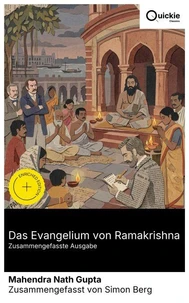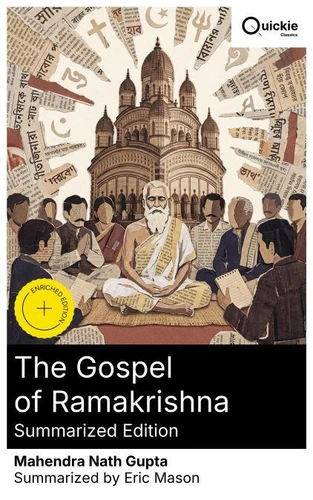
The Gospel of Ramakrishna (Summarized Edition). Enriched edition. 19th-century Hindu philosophy and spiritual teachings: disciples' diary, philosophic dialogues, and paths to Eastern enlightenment
Par : , ,Formats :
Disponible dans votre compte client Decitre ou Furet du Nord dès validation de votre commande. Le format ePub est :
- Compatible avec une lecture sur My Vivlio (smartphone, tablette, ordinateur)
- Compatible avec une lecture sur liseuses Vivlio
- Pour les liseuses autres que Vivlio, vous devez utiliser le logiciel Adobe Digital Edition. Non compatible avec la lecture sur les liseuses Kindle, Remarkable et Sony
 , qui est-ce ?
Notre partenaire de plateforme de lecture numérique où vous retrouverez l'ensemble de vos ebooks gratuitement
Pour en savoir plus sur nos ebooks, consultez notre aide en ligne ici
C'est si simple ! Lisez votre ebook avec l'app Vivlio sur votre tablette, mobile ou ordinateur :

- Nombre de pages124
- FormatePub
- ISBN859-65--4787917-6
- EAN8596547879176
- Date de parution10/01/2026
- Protection num.Digital Watermarking
- Taille980 Ko
- Infos supplémentairesepub
- ÉditeurQUICKIE CLASSICS
Résumé
The Gospel of Ramakrishna distills Mahendra Nath Gupta's meticulous, date-stamped chronicles of Sri Ramakrishna's conversations at Dakshineswar during the Bengal Renaissance. Composed in a spare, diaristic style-part stenographic transcript, part dramatic vignette-the book preserves the living cadence of oral teaching: parable, colloquial banter, scripture-laced aphorism, and sudden bursts of bhava.
It situates Ramakrishna's ecstatic Advaita-inflected bhakti within a plural, colonial milieu, registering his engagements with Tantra, Vaishnavism, Vedanta, as well as Islam and Christianity, and the everyday textures of a bhadralok devotional salon. Gupta-known to readers as "M."-was a Calcutta schoolmaster trained in English education and embedded in the emerging middle-class culture. A householder devotee and careful observer, he began visiting Ramakrishna in 1882, keeping contemporaneous notes with times, places, and dramatis personae.
His restraint, self-effacing narrative stance, and bilingual milieu yielded a document at once intimate and critically precise, later shaped in Bengali as Sri Sri Ramakrishna Kathamrita and widely known in English as The Gospel of Ramakrishna. For scholars of religion, South Asian history, and literary ethnography-as well as seekers-this book offers a rare phenomenology of lived devotion and pedagogy.
Read it for method and music: precision, humility, and spiritual intensity. Quickie Classics summarizes timeless works with precision, preserving the author's voice and keeping the prose clear, fast, and readable-distilled, never diluted. Enriched Edition extras: Introduction · Synopsis · Historical Context · Brief Analysis · 4 Reflection Q&As · Editorial Footnotes.
It situates Ramakrishna's ecstatic Advaita-inflected bhakti within a plural, colonial milieu, registering his engagements with Tantra, Vaishnavism, Vedanta, as well as Islam and Christianity, and the everyday textures of a bhadralok devotional salon. Gupta-known to readers as "M."-was a Calcutta schoolmaster trained in English education and embedded in the emerging middle-class culture. A householder devotee and careful observer, he began visiting Ramakrishna in 1882, keeping contemporaneous notes with times, places, and dramatis personae.
His restraint, self-effacing narrative stance, and bilingual milieu yielded a document at once intimate and critically precise, later shaped in Bengali as Sri Sri Ramakrishna Kathamrita and widely known in English as The Gospel of Ramakrishna. For scholars of religion, South Asian history, and literary ethnography-as well as seekers-this book offers a rare phenomenology of lived devotion and pedagogy.
Read it for method and music: precision, humility, and spiritual intensity. Quickie Classics summarizes timeless works with precision, preserving the author's voice and keeping the prose clear, fast, and readable-distilled, never diluted. Enriched Edition extras: Introduction · Synopsis · Historical Context · Brief Analysis · 4 Reflection Q&As · Editorial Footnotes.