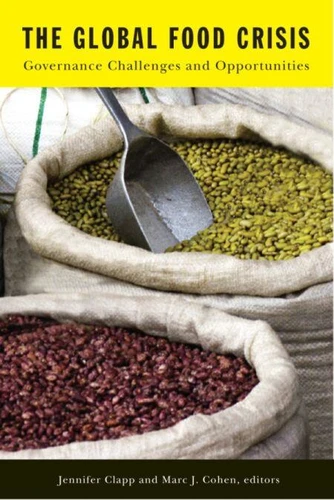
The Global Food Crisis. Governance Challenges and Opportunities
Par : ,Formats :
Disponible dans votre compte client Decitre ou Furet du Nord dès validation de votre commande. Le format ePub est :
- Compatible avec une lecture sur My Vivlio (smartphone, tablette, ordinateur)
- Compatible avec une lecture sur liseuses Vivlio
- Pour les liseuses autres que Vivlio, vous devez utiliser le logiciel Adobe Digital Edition. Non compatible avec la lecture sur les liseuses Kindle, Remarkable et Sony
 , qui est-ce ?
Notre partenaire de plateforme de lecture numérique où vous retrouverez l'ensemble de vos ebooks gratuitement
Pour en savoir plus sur nos ebooks, consultez notre aide en ligne ici
C'est si simple ! Lisez votre ebook avec l'app Vivlio sur votre tablette, mobile ou ordinateur :

- Nombre de pages288
- FormatePub
- ISBN978-1-55458-275-4
- EAN9781554582754
- Date de parution30/09/2009
- Protection num.Digital Watermarking
- Taille19 Mo
- Infos supplémentairesepub
- ÉditeurWilfrid Laurier University Press
Résumé
The global food crisis is a stark reminder of the fragility of the global food system. The Global Food Crisis: Governance Challenges and Opportunities captures the debate about how to go forward and examines the implications of the crisis for food security in the world's poorest countries, both for the global environment and for the global rules and institutions that govern food and agriculture. In this volume, policy-makers and scholars assess the causes and consequences of the most recent food price volatility and examine the associated governance challenges and opportunities, including short-term emergency responses, the ecological dimensions of the crisis, and the longer-term goal of building sustainable global food systems.
The recommendations include vastly increasing public investment in small-farm agriculture; reforming global food aid and food research institutions; establishing fairer international agricultural trade rules; promoting sustainable agricultural methods; placing agriculture higher on the post-Kyoto climate change agenda; revamping biofuel policies; and enhancing international agricultural policy-making.
Co-published with the Centre for International Governance Innovation
The recommendations include vastly increasing public investment in small-farm agriculture; reforming global food aid and food research institutions; establishing fairer international agricultural trade rules; promoting sustainable agricultural methods; placing agriculture higher on the post-Kyoto climate change agenda; revamping biofuel policies; and enhancing international agricultural policy-making.
Co-published with the Centre for International Governance Innovation