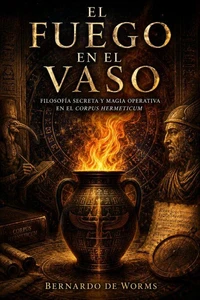
The Fire in the Vessel offers a profound journey through the history, philosophy, and operative mysteries of the Hermetic tradition. From the ancient temples of Egypt and the cosmopolitan world of Alexandria to the Islamic transmission of Hermetic knowledge and its triumphant revival during the Renaissance, Bernardo de Worms reconstructs the remarkable path followed by a body of wisdom attributed to Hermes Trismegistus.
Drawing upon the Corpus Hermeticum, the Poimandres, the Asclepius, the fragments preserved by Stobaeus, the Coptic manuscripts of Nag Hammadi, and the visionary writings of early alchemists such as Zosimos of Panopolis, the book explores the fundamental teachings of Hermetism: the divine origin of the human soul, the living unity of the cosmos, the hidden correspondences linking stars, plants, minerals, and human beings, and the possibility of spiritual regeneration through gnosis.
The study also enters the practical dimension of the Hermetic arts. Astrology, sacred medicine, talismanic magic, theurgy, and alchemy are presented not as isolated superstitions, but as interconnected disciplines founded upon a single vision of nature. The laboratory becomes a mirror of the universe; the alchemical vessel reflects the purified human mind; and the transmutation of metals becomes an image of the soul's passage from ignorance to illumination.
Combining historical research, philosophical interpretation, and a vivid exploration of ancient texts and rituals, The Fire in the Vessel reveals Hermetism as one of the great underground currents of Western thought. At its heart lies an enduring and audacious idea: the human being is a bridge between matter and spirit, a living microcosm capable of receiving the fire of divine Mind and awakening to its forgotten immortality.
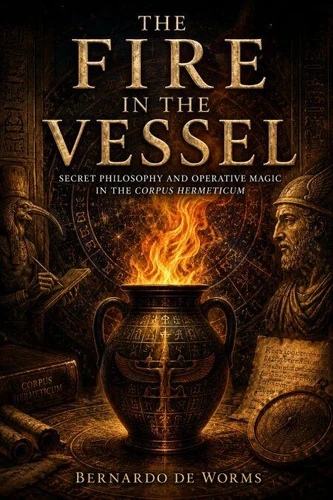
The Fire in the Vessel offers a profound journey through the history, philosophy, and operative mysteries of the Hermetic tradition. From the ancient temples of Egypt and the cosmopolitan world of Alexandria to the Islamic transmission of Hermetic knowledge and its triumphant revival during the Renaissance, Bernardo de Worms reconstructs the remarkable path followed by a body of wisdom attributed to Hermes Trismegistus.
Drawing upon the Corpus Hermeticum, the Poimandres, the Asclepius, the fragments preserved by Stobaeus, the Coptic manuscripts of Nag Hammadi, and the visionary writings of early alchemists such as Zosimos of Panopolis, the book explores the fundamental teachings of Hermetism: the divine origin of the human soul, the living unity of the cosmos, the hidden correspondences linking stars, plants, minerals, and human beings, and the possibility of spiritual regeneration through gnosis.
The study also enters the practical dimension of the Hermetic arts. Astrology, sacred medicine, talismanic magic, theurgy, and alchemy are presented not as isolated superstitions, but as interconnected disciplines founded upon a single vision of nature. The laboratory becomes a mirror of the universe; the alchemical vessel reflects the purified human mind; and the transmutation of metals becomes an image of the soul's passage from ignorance to illumination.
Combining historical research, philosophical interpretation, and a vivid exploration of ancient texts and rituals, The Fire in the Vessel reveals Hermetism as one of the great underground currents of Western thought. At its heart lies an enduring and audacious idea: the human being is a bridge between matter and spirit, a living microcosm capable of receiving the fire of divine Mind and awakening to its forgotten immortality.

 , qui est-ce ?