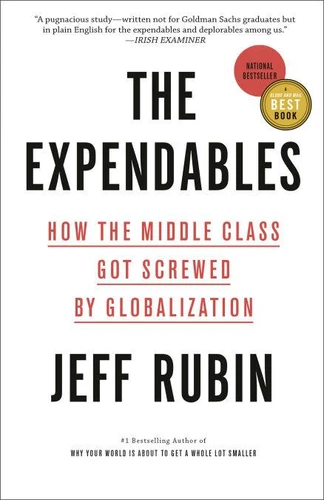
The Expendables. How the Middle Class Got Screwed By Globalization
Par :Formats :
Disponible dans votre compte client Decitre ou Furet du Nord dès validation de votre commande. Le format ePub protégé est :
- Compatible avec une lecture sur My Vivlio (smartphone, tablette, ordinateur)
- Compatible avec une lecture sur liseuses Vivlio
- Pour les liseuses autres que Vivlio, vous devez utiliser le logiciel Adobe Digital Edition. Non compatible avec la lecture sur les liseuses Kindle, Remarkable et Sony
- Non compatible avec un achat hors France métropolitaine
 , qui est-ce ?
Notre partenaire de plateforme de lecture numérique où vous retrouverez l'ensemble de vos ebooks gratuitement
Pour en savoir plus sur nos ebooks, consultez notre aide en ligne ici
C'est si simple ! Lisez votre ebook avec l'app Vivlio sur votre tablette, mobile ou ordinateur :

- Nombre de pages304
- FormatePub
- ISBN978-0-7352-7940-7
- EAN9780735279407
- Date de parution18/08/2020
- Protection num.Adobe DRM
- Taille947 Ko
- Infos supplémentairesepub
- ÉditeurRandom House Canada
Résumé
From the #1 bestselling author of Why Your World Is About to Get A Whole Lot Smaller, a provocative, far-reaching account of how the middle class got stuck with the bill for globalization, and how the blowback-from Brexit to Trump to populist Europe-will change the developed world. Real wages in North America have not risen since the 1970s. Union membership has collapsed. Full-time employment is beginning to look like a quaint idea from the distant past.
If it seems that the middle class is in retreat around the developed world, it is. Former CIBC World Markets Chief Economist Jeff Rubin argues that all this was foreseeable back when Canada, the United States and Mexico first started talking free trade. Labour argued then that manufacturing jobs would move to Mexico. Free-trade advocates disagreed. Today, Canadian and American factories sit idle.
More steel is used to make bottlecaps than cars. Meanwhile, Mexico has become one of the world's biggest automotive exporters. And it's not just NAFTA. Cheap oil, low interest rates, global deregulation and tax policies that benefit the rich all have the same effect: the erosion of the middle class. Growing global inequality is a problem of our own making, Rubin argues. And solving it won't be easy if we draw on the same ideas about capital and labour, right and left, that led us to this cliff.
Articulating a vision that dovetails with the ideas of both Naomi Klein and Donald Trump, The Expendables is an exhilaratingly fresh perspective that is at once humane and irascible, fearless and rigorous, and most importantly, timely. GDP is growing, the stock market is up and unemployment is down, but the surprise of the book is that even the good news is good for only one percent of us.
If it seems that the middle class is in retreat around the developed world, it is. Former CIBC World Markets Chief Economist Jeff Rubin argues that all this was foreseeable back when Canada, the United States and Mexico first started talking free trade. Labour argued then that manufacturing jobs would move to Mexico. Free-trade advocates disagreed. Today, Canadian and American factories sit idle.
More steel is used to make bottlecaps than cars. Meanwhile, Mexico has become one of the world's biggest automotive exporters. And it's not just NAFTA. Cheap oil, low interest rates, global deregulation and tax policies that benefit the rich all have the same effect: the erosion of the middle class. Growing global inequality is a problem of our own making, Rubin argues. And solving it won't be easy if we draw on the same ideas about capital and labour, right and left, that led us to this cliff.
Articulating a vision that dovetails with the ideas of both Naomi Klein and Donald Trump, The Expendables is an exhilaratingly fresh perspective that is at once humane and irascible, fearless and rigorous, and most importantly, timely. GDP is growing, the stock market is up and unemployment is down, but the surprise of the book is that even the good news is good for only one percent of us.