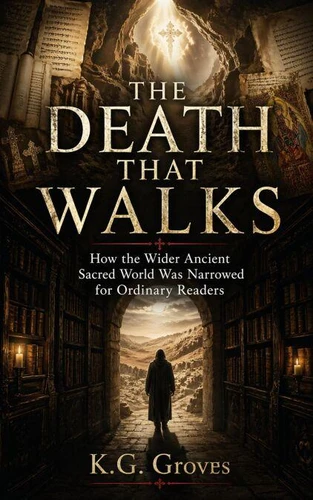
Most readers inherit a finished Bible. It feels complete. Settled. Closed. But what if the shelf was never the whole room?The Death That Walks is a serious, evidence-aware exploration of the wider ancient sacred world that existed alongside and beyond the familiar Western canon. Drawing from the Roman Catholic canon, the Ethiopian Orthodox tradition, and the textual universe reflected in the Dead Sea Scrolls, this book does not collapse differences into conspiracy or confusion.
Instead, it carefully distinguishes them-revealing a more complex and historically grounded picture of how sacred boundaries formed. At the center of the book is a harder question than canon lists:What if the deepest form of death is not physical, but spiritual-alive in appearance, yet inwardly vacant?Through disciplined analysis and controlled prose, K. G. Groves examines: how canon functioned as a boundary, not totality what ancient Jews and Christians actually lived among textually and spiritually how narrowing occurred through history, authority, and practical religious life what kinds of spiritual imagination were lost to ordinary readers and how the concept of "the death that walks" reframes faith itself This is not a book of sensational claims.
It is a book of scale. A book that restores atmosphere, tension, and seriousness to the sacred world-while clearly separating historical evidence from interpretation. For readers who suspect that what they inherited was real-but not the whole.
Most readers inherit a finished Bible. It feels complete. Settled. Closed. But what if the shelf was never the whole room?The Death That Walks is a serious, evidence-aware exploration of the wider ancient sacred world that existed alongside and beyond the familiar Western canon. Drawing from the Roman Catholic canon, the Ethiopian Orthodox tradition, and the textual universe reflected in the Dead Sea Scrolls, this book does not collapse differences into conspiracy or confusion.
Instead, it carefully distinguishes them-revealing a more complex and historically grounded picture of how sacred boundaries formed. At the center of the book is a harder question than canon lists:What if the deepest form of death is not physical, but spiritual-alive in appearance, yet inwardly vacant?Through disciplined analysis and controlled prose, K. G. Groves examines: how canon functioned as a boundary, not totality what ancient Jews and Christians actually lived among textually and spiritually how narrowing occurred through history, authority, and practical religious life what kinds of spiritual imagination were lost to ordinary readers and how the concept of "the death that walks" reframes faith itself This is not a book of sensational claims.
It is a book of scale. A book that restores atmosphere, tension, and seriousness to the sacred world-while clearly separating historical evidence from interpretation. For readers who suspect that what they inherited was real-but not the whole.

 , qui est-ce ?