
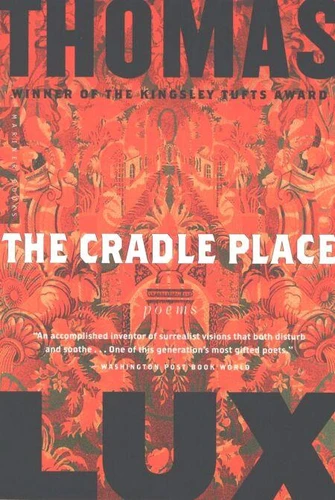
THOMAS LUX holds the Bourne Chair in Poetry and is the director of the McEver Visiting Writers Program at Georgia Institute of Technology. He has been awarded three NEA grants and the Kingsley Tufts Award and is a former Guggenheim Fellow. He lives in Atlanta.
The Cradle Place. Poems
Par :Formats :
Disponible dans votre compte client Decitre ou Furet du Nord dès validation de votre commande. Le format ePub protégé est :
- Compatible avec une lecture sur My Vivlio (smartphone, tablette, ordinateur)
- Compatible avec une lecture sur liseuses Vivlio
- Pour les liseuses autres que Vivlio, vous devez utiliser le logiciel Adobe Digital Edition. Non compatible avec la lecture sur les liseuses Kindle, Remarkable et Sony
- Non compatible avec un achat hors France métropolitaine
 , qui est-ce ?
Notre partenaire de plateforme de lecture numérique où vous retrouverez l'ensemble de vos ebooks gratuitement
Pour en savoir plus sur nos ebooks, consultez notre aide en ligne ici
C'est si simple ! Lisez votre ebook avec l'app Vivlio sur votre tablette, mobile ou ordinateur :

- Nombre de pages80
- FormatePub
- ISBN978-0-547-34708-0
- EAN9780547347080
- Date de parution06/08/2007
- Protection num.Adobe DRM
- Infos supplémentairesepub
- ÉditeurEcco
Résumé
The Cradle Place is a collection from Thomas Lux, a self-described "recovering surrealist" and winner of the Kingsley Tufts Award. These fifty-two poems bring to full life the "refreshing iconoclasms" Rita Dove so admired in Lux's earlier work. His voice is plainspoken but moody, humorous and edgy, and ever surprising. These are philosophical poems that ask questions about language and intention, about the sometimes untidy connections between the human and natural worlds.
In the poem "Terminal Lake, " Lux undermines notions of benign nature, finding dark currents beneath the surface: "it's a huge black coin, / it's as if the real lake is drained / and this lake is the drain: gaping, language- / less, suck- and sinkhole." In the ominous "Render, Render, " the narrator asks us to consider a concentration of the essences of our lives: all that is physical, spiritual, remembered, and dreamed for, melded together to make the messy self we present to the world.
Lux's voice is intelligent without being bookish, urgent and unrelentingly evocative. He has long been a strong advocate for the relevance of poetry in American culture. The Los Angeles Times praises Lux for his "compelling rhythms, his biting irony, and his steady devotion to a craft that often seems thankless." As Sven Birkerts noted, "Lux may be one of the poets on whom the future of the genre depends."
In the poem "Terminal Lake, " Lux undermines notions of benign nature, finding dark currents beneath the surface: "it's a huge black coin, / it's as if the real lake is drained / and this lake is the drain: gaping, language- / less, suck- and sinkhole." In the ominous "Render, Render, " the narrator asks us to consider a concentration of the essences of our lives: all that is physical, spiritual, remembered, and dreamed for, melded together to make the messy self we present to the world.
Lux's voice is intelligent without being bookish, urgent and unrelentingly evocative. He has long been a strong advocate for the relevance of poetry in American culture. The Los Angeles Times praises Lux for his "compelling rhythms, his biting irony, and his steady devotion to a craft that often seems thankless." As Sven Birkerts noted, "Lux may be one of the poets on whom the future of the genre depends."
A propos de Thomas Lux
Split Horizon
E-book
8,99 €
Half Promised Land
E-book
7,99 €
To The Left Of Time
E-book
9,99 €
15,99 €
God Particles. Poems
E-book
15,99 €
9,99 €