
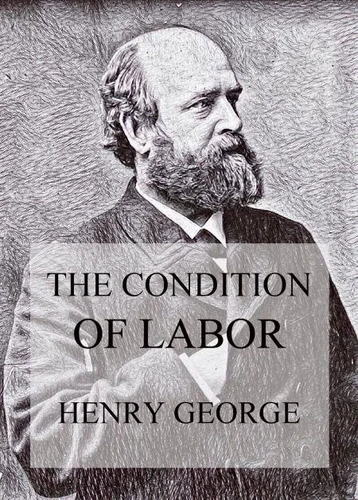
The Condition of Labor
Par :Formats :
Disponible dans votre compte client Decitre ou Furet du Nord dès validation de votre commande. Le format ePub est :
- Compatible avec une lecture sur My Vivlio (smartphone, tablette, ordinateur)
- Compatible avec une lecture sur liseuses Vivlio
- Pour les liseuses autres que Vivlio, vous devez utiliser le logiciel Adobe Digital Edition. Non compatible avec la lecture sur les liseuses Kindle, Remarkable et Sony
 , qui est-ce ?
Notre partenaire de plateforme de lecture numérique où vous retrouverez l'ensemble de vos ebooks gratuitement
Pour en savoir plus sur nos ebooks, consultez notre aide en ligne ici
C'est si simple ! Lisez votre ebook avec l'app Vivlio sur votre tablette, mobile ou ordinateur :

- Nombre de pages208
- FormatePub
- ISBN978-3-8496-5804-5
- EAN9783849658045
- Date de parution10/06/2020
- Protection num.Digital Watermarking
- Taille619 Ko
- Infos supplémentairesepub
- ÉditeurJAZZYBEE VERLAG
Résumé
This earnest and eloquent Letter to the Pope is by far the most remarkable utterance which the Encyclical of 1890 has evoked. The Pope could not have found a fitter controversialist to oppose him, for Mr. George meets him on the same basis of metaphysical theology, and appeals to the same authority of Scripture and St. Thomas of Aquino. And the whole letter seems, in its manner, curiously to echo the Pope ' s own dignified ecclesiastical - Latin style.
Mr. George feels that the Encyclical is directed more strongly against his own "single tax" panacea than against what is vaguely called Socialism, which in a moderate form it favors. The Pope expressly puts property in land on the same level with property of any other kind, and expressly maintains that private property in this wide sense is a "natural right" of man, prior to the formation of any State.
Mr. George, like the Pope, believes in " natural rights; "but he works out this vague and treacherous conception in his own way. "The right of property, " he says, "attaches to things produced by labor, but cannot attach to things created by God. Thus, if a man take a fish from the ocean he acquires a right of property in that fish, which exclusive right he may transfer by sale or gift. But he cannot obtain a similar right of property in the ocean, so that he may sell it, or give it, or forbid others to use it." Does Mr.
George mean that the fish was not created by God ? He can hardly expect his Holiness to believe that; nor are any of us likely to believe that it was " produced " by the fisherman in any sense in which a great deal of land has not been produced " by human labor. The antithesis of God or " Nature " to everything that is done by human effort runs through all Mr. George ' s arguments. " Socialism in all its phases, " he says, " looks on the evils of our civilization as springing from the inadequacy or inharmony of natural relations, which must be artificially organized or improved.
In its idea there devolves on the State the necessity of intelligently organizing the industrial relations of men, the construction, as it were, of a great machine, whose complicated parts shall properly work together under the direction of human intelligence. This is the reason why socialism tends towards atheism. Failing to see the order and symmetry of natural law, it fails to recognize God." Mr.
George seems to think that the work of human intelligence goes on in spite of God, and is somehow outside "Nature." This, though a very common way of thinking, is very questionable philosophy, and the Pope would hardly approve of it as theology. Mr. George undertakes a hard task when he tries to persuade the head of the Catholic Church that " interest is natural and just, " while land - owning is wrong.
But he makes a very strong point when he shows that the Pope ' s argument, " that what is bought with rightful property is rightful property, " could be used to justify slave - owning as easily as to justify property in land.
Mr. George feels that the Encyclical is directed more strongly against his own "single tax" panacea than against what is vaguely called Socialism, which in a moderate form it favors. The Pope expressly puts property in land on the same level with property of any other kind, and expressly maintains that private property in this wide sense is a "natural right" of man, prior to the formation of any State.
Mr. George, like the Pope, believes in " natural rights; "but he works out this vague and treacherous conception in his own way. "The right of property, " he says, "attaches to things produced by labor, but cannot attach to things created by God. Thus, if a man take a fish from the ocean he acquires a right of property in that fish, which exclusive right he may transfer by sale or gift. But he cannot obtain a similar right of property in the ocean, so that he may sell it, or give it, or forbid others to use it." Does Mr.
George mean that the fish was not created by God ? He can hardly expect his Holiness to believe that; nor are any of us likely to believe that it was " produced " by the fisherman in any sense in which a great deal of land has not been produced " by human labor. The antithesis of God or " Nature " to everything that is done by human effort runs through all Mr. George ' s arguments. " Socialism in all its phases, " he says, " looks on the evils of our civilization as springing from the inadequacy or inharmony of natural relations, which must be artificially organized or improved.
In its idea there devolves on the State the necessity of intelligently organizing the industrial relations of men, the construction, as it were, of a great machine, whose complicated parts shall properly work together under the direction of human intelligence. This is the reason why socialism tends towards atheism. Failing to see the order and symmetry of natural law, it fails to recognize God." Mr.
George seems to think that the work of human intelligence goes on in spite of God, and is somehow outside "Nature." This, though a very common way of thinking, is very questionable philosophy, and the Pope would hardly approve of it as theology. Mr. George undertakes a hard task when he tries to persuade the head of the Catholic Church that " interest is natural and just, " while land - owning is wrong.
But he makes a very strong point when he shows that the Pope ' s argument, " that what is bought with rightful property is rightful property, " could be used to justify slave - owning as easily as to justify property in land.
A propos de Henry George

Progress And Poverty (Unabridged)
Audiobook
2,99 €
4,99 €
Property in Land
E-book
1,99 €
Progress and Poverty
E-book
2,99 €
Protection or Free Trade
E-book
2,99 €
Social Problems
E-book
1,99 €