
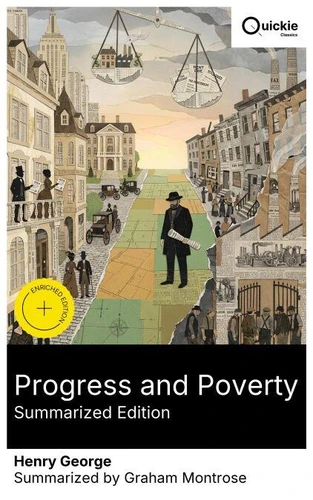
Progress and Poverty (Summarized Edition). Enriched edition. Analyzing inequality and poverty's roots with a bold single-tax remedy in a landmark 19th-century critique of political economy
Par : , ,Formats :
Disponible dans votre compte client Decitre ou Furet du Nord dès validation de votre commande. Le format ePub est :
- Compatible avec une lecture sur My Vivlio (smartphone, tablette, ordinateur)
- Compatible avec une lecture sur liseuses Vivlio
- Pour les liseuses autres que Vivlio, vous devez utiliser le logiciel Adobe Digital Edition. Non compatible avec la lecture sur les liseuses Kindle, Remarkable et Sony
 , qui est-ce ?
Notre partenaire de plateforme de lecture numérique où vous retrouverez l'ensemble de vos ebooks gratuitement
Pour en savoir plus sur nos ebooks, consultez notre aide en ligne ici
C'est si simple ! Lisez votre ebook avec l'app Vivlio sur votre tablette, mobile ou ordinateur :

- Nombre de pages160
- FormatePub
- ISBN859-65--4788080-6
- EAN8596547880806
- Date de parution10/01/2026
- Protection num.Digital Watermarking
- Taille951 Ko
- Infos supplémentairesepub
- ÉditeurQUICKIE CLASSICS
Résumé
In Progress and Poverty, Volumes I and II, Henry George tackles the puzzle of rising wealth amid persistent want. In lucid, polemical prose that fuses moral philosophy with political economy, he reworks classical theories of rent, wages, and interest, indicts speculative landholding, and advances the single tax on land values. Set against Gilded Age depressions, the work moves from diagnosis to institutional remedy.
George, a self-taught printer and journalist, forged his economics from experience in California's land booms, railroad privilege, and the Long Depression of the 1870s. Observing unemployment amid mechanization and urban squalor, he embraced a natural-rights republicanism hostile to monopoly. His reporting furnished cases; his moral imagination and rigorous deduction supplied the architecture of this reformist treatise.
Recommended to economists, historians, urban planners, and engaged citizens, this book provides a disciplined framework for confronting inequality, housing scarcity, and tax design. As both historical document and policy blueprint, it clarifies how public capture of land rents can align growth with justice-making George's argument strikingly contemporary and essential. Quickie Classics summarizes timeless works with precision, preserving the author's voice and keeping the prose clear, fast, and readable-distilled, never diluted.
Enriched Edition extras: Introduction · Synopsis · Historical Context · Brief Analysis · 4 Reflection Q&As · Editorial Footnotes.
George, a self-taught printer and journalist, forged his economics from experience in California's land booms, railroad privilege, and the Long Depression of the 1870s. Observing unemployment amid mechanization and urban squalor, he embraced a natural-rights republicanism hostile to monopoly. His reporting furnished cases; his moral imagination and rigorous deduction supplied the architecture of this reformist treatise.
Recommended to economists, historians, urban planners, and engaged citizens, this book provides a disciplined framework for confronting inequality, housing scarcity, and tax design. As both historical document and policy blueprint, it clarifies how public capture of land rents can align growth with justice-making George's argument strikingly contemporary and essential. Quickie Classics summarizes timeless works with precision, preserving the author's voice and keeping the prose clear, fast, and readable-distilled, never diluted.
Enriched Edition extras: Introduction · Synopsis · Historical Context · Brief Analysis · 4 Reflection Q&As · Editorial Footnotes.
A propos de Henry George


Progress And Poverty (Unabridged)
Audiobook
2,99 €
4,99 €
Property in Land
E-book
1,99 €
The Condition of Labor
E-book
1,99 €
Social Problems
E-book
1,99 €
Progress and Poverty
E-book
2,99 €

Protection or Free Trade
E-book
2,99 €