The forward shoots. The ball goes wide. "He should have seen the teammate at the back post, " says the coach. And he was right - the teammate was free. But the real question is not what the player should have done. It is why he did not do it - a decision already made milliseconds before the ball arrived, invisibly, in his cognitive architecture. For decades, we were taught to read error as technical failure: the pass that didn't arrive, the shot that went wide.
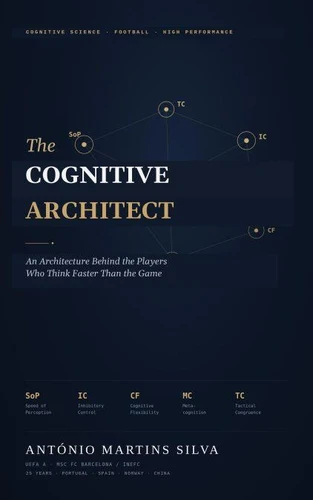
But the error in execution is only the visible symptom. The real cause operated milliseconds earlier - in the game nobody trains. In The Cognitive Architect, António Martins Silva (UEFA A, MSc in High Performance from FC Barcelona / INEFC) distils 25 years across Portugal, Spain, Norway and China into a five-variable model for identifying, assessing and developing a player's tactical intelligence: SoP - Speed of Perception IC - Inhibitory Control CF - Cognitive Flexibility MC - Metacognition TC - Tactical Congruence The model is built on Francisco Seirul·lo's cognitive cycle and Vítor Frade's Tactical Periodization - two of the most influential schools of thought in European football - interpreted through the lens of applied cognitive science.
This book does not offer closed recipes. It offers criteria. Its final section, Field Tools, is a complete practical manual: twelve chapters of application with exercises, cognitive constraints in play and observation protocols, ready to adapt to your context by Monday. It also includes the Reliability System - an instrument to diagnose and prescribe cognitive training - and the concept of the Vertical Club, for technical directors who want to align the architecture of an entire club.
With an endorsement from Vítor Frade (creator of Tactical Periodization), a foreword by Agustín Peraita Serra (author of Espacios de Fase), and words from Xesco Espar (INEFC Barcelona) and professional player Birk Risa (Molde FK, ex-New York City FC). The answers for the football of the future are not in closed manuals. They are in your player's eyes in the eighty-seventh minute.
The forward shoots. The ball goes wide. "He should have seen the teammate at the back post, " says the coach. And he was right - the teammate was free. But the real question is not what the player should have done. It is why he did not do it - a decision already made milliseconds before the ball arrived, invisibly, in his cognitive architecture. For decades, we were taught to read error as technical failure: the pass that didn't arrive, the shot that went wide.
But the error in execution is only the visible symptom. The real cause operated milliseconds earlier - in the game nobody trains. In The Cognitive Architect, António Martins Silva (UEFA A, MSc in High Performance from FC Barcelona / INEFC) distils 25 years across Portugal, Spain, Norway and China into a five-variable model for identifying, assessing and developing a player's tactical intelligence: SoP - Speed of Perception IC - Inhibitory Control CF - Cognitive Flexibility MC - Metacognition TC - Tactical Congruence The model is built on Francisco Seirul·lo's cognitive cycle and Vítor Frade's Tactical Periodization - two of the most influential schools of thought in European football - interpreted through the lens of applied cognitive science.
This book does not offer closed recipes. It offers criteria. Its final section, Field Tools, is a complete practical manual: twelve chapters of application with exercises, cognitive constraints in play and observation protocols, ready to adapt to your context by Monday. It also includes the Reliability System - an instrument to diagnose and prescribe cognitive training - and the concept of the Vertical Club, for technical directors who want to align the architecture of an entire club.
With an endorsement from Vítor Frade (creator of Tactical Periodization), a foreword by Agustín Peraita Serra (author of Espacios de Fase), and words from Xesco Espar (INEFC Barcelona) and professional player Birk Risa (Molde FK, ex-New York City FC). The answers for the football of the future are not in closed manuals. They are in your player's eyes in the eighty-seventh minute.