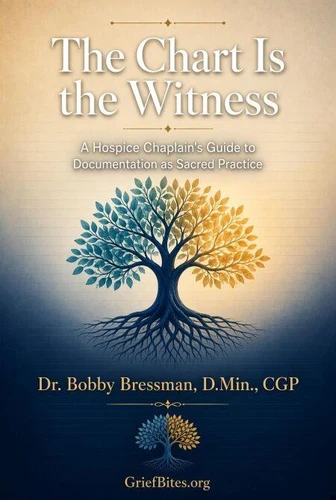
In hospice, the chart is often the only place the whole team can meet the patient when they cannot be present themselves. For chaplains, that reality has long created tension: the sacred encounter feels too large for an EMR text box, yet silence in the record erases the very story the team needs. The Chart Is the Witness resolves that tension with both theological depth and clinical precision. Dr.
Bobby Bressman, a veteran hospice chaplain, pastor, and CPEI supervisor-in-training, argues that documentation is not the leftover administrative residue of ministry-it is a continuation of presence. Rooted in the biblical practice of remembering and the posture of hesed (steadfast, particular love), the book reframes charting as bearing faithful witness. Using Walter Brueggemann's orientation-disorientation-reorientation trajectory, Bressman teaches chaplains how to track a patient's spiritual journey with enough specificity that nurses, social workers, and bereavement counselors can act on it.
The heart of the book is a rich casebook of encounters-initial assessments, stoic patients, caregiver collapse, guilt and passive death wishes, nonverbal patients, death vigils, bereavement follow-up, interfaith care, family conflict, active substance use, and moral distress at IDG-each written in multiple documentation formats (DAROP, Memorial Hermann five-part, SOAP, and Spiritual AIM) with line-by-line commentary and CPE learning edges.
Readers see exactly how to capture what was said, what was observed, what the chaplain did, and what changed, without flattening the sacred or editorializing the family. Because hospice is interdisciplinary by design, the book speaks directly to the partnership between chaplaincy and social work. Clear spiritual documentation flags caregiver isolation, anticipatory grief, reconciliation possibilities, and safety concerns that social workers need for timely interventions and risk-stratified bereavement planning.
The same principles of observable language, direct quotation, and disciplined self-awareness that form good chaplain notes also strengthen social work documentation and reduce the friction that occurs when disciplines speak different clinical dialects. Practical tools round out the volume: a six-item charting checklist, "phrases that help and phrases that hurt, " a fifteen-minute documentation audit, a 30-60-90 day onboarding plan for new chaplains, and guidance for building peer accountability when formal CPE groups are no longer available.
Regulatory realities-Medicare Conditions of Participation, Joint Commission tracers, APC Standards of Practice, HIPAA basics, and the subpoena reality-are treated not as external threats but as further reasons to write with integrity. Written from the author's own "limp"-personal loss, pastoral trauma, and burnout-The Chart Is the Witness offers more than technique. It offers a sustainable way for chaplains and the social workers who walk alongside them to carry the weight of this work without losing the unrepeatable people entrusted to their care.
The result is documentation that serves the patient, the family, the team, and the chaplain's own ongoing formation-notes written as if someone is reading, because someone always is.
In hospice, the chart is often the only place the whole team can meet the patient when they cannot be present themselves. For chaplains, that reality has long created tension: the sacred encounter feels too large for an EMR text box, yet silence in the record erases the very story the team needs. The Chart Is the Witness resolves that tension with both theological depth and clinical precision. Dr.
Bobby Bressman, a veteran hospice chaplain, pastor, and CPEI supervisor-in-training, argues that documentation is not the leftover administrative residue of ministry-it is a continuation of presence. Rooted in the biblical practice of remembering and the posture of hesed (steadfast, particular love), the book reframes charting as bearing faithful witness. Using Walter Brueggemann's orientation-disorientation-reorientation trajectory, Bressman teaches chaplains how to track a patient's spiritual journey with enough specificity that nurses, social workers, and bereavement counselors can act on it.
The heart of the book is a rich casebook of encounters-initial assessments, stoic patients, caregiver collapse, guilt and passive death wishes, nonverbal patients, death vigils, bereavement follow-up, interfaith care, family conflict, active substance use, and moral distress at IDG-each written in multiple documentation formats (DAROP, Memorial Hermann five-part, SOAP, and Spiritual AIM) with line-by-line commentary and CPE learning edges.
Readers see exactly how to capture what was said, what was observed, what the chaplain did, and what changed, without flattening the sacred or editorializing the family. Because hospice is interdisciplinary by design, the book speaks directly to the partnership between chaplaincy and social work. Clear spiritual documentation flags caregiver isolation, anticipatory grief, reconciliation possibilities, and safety concerns that social workers need for timely interventions and risk-stratified bereavement planning.
The same principles of observable language, direct quotation, and disciplined self-awareness that form good chaplain notes also strengthen social work documentation and reduce the friction that occurs when disciplines speak different clinical dialects. Practical tools round out the volume: a six-item charting checklist, "phrases that help and phrases that hurt, " a fifteen-minute documentation audit, a 30-60-90 day onboarding plan for new chaplains, and guidance for building peer accountability when formal CPE groups are no longer available.
Regulatory realities-Medicare Conditions of Participation, Joint Commission tracers, APC Standards of Practice, HIPAA basics, and the subpoena reality-are treated not as external threats but as further reasons to write with integrity. Written from the author's own "limp"-personal loss, pastoral trauma, and burnout-The Chart Is the Witness offers more than technique. It offers a sustainable way for chaplains and the social workers who walk alongside them to carry the weight of this work without losing the unrepeatable people entrusted to their care.
The result is documentation that serves the patient, the family, the team, and the chaplain's own ongoing formation-notes written as if someone is reading, because someone always is.