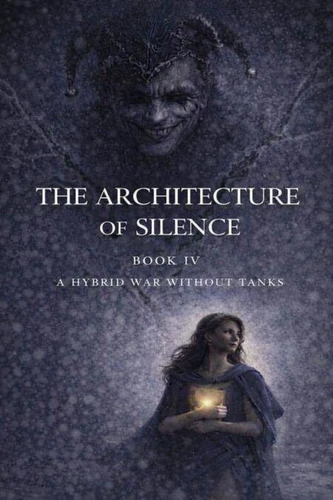
The Architecture of Silence. A Hybrid War Without Tanks, #4
Par :Formats :
Disponible dans votre compte client Decitre ou Furet du Nord dès validation de votre commande. Le format ePub est :
- Compatible avec une lecture sur My Vivlio (smartphone, tablette, ordinateur)
- Compatible avec une lecture sur liseuses Vivlio
- Pour les liseuses autres que Vivlio, vous devez utiliser le logiciel Adobe Digital Edition. Non compatible avec la lecture sur les liseuses Kindle, Remarkable et Sony
 , qui est-ce ?
Notre partenaire de plateforme de lecture numérique où vous retrouverez l'ensemble de vos ebooks gratuitement
Pour en savoir plus sur nos ebooks, consultez notre aide en ligne ici
C'est si simple ! Lisez votre ebook avec l'app Vivlio sur votre tablette, mobile ou ordinateur :

- FormatePub
- ISBN8233193590
- EAN9798233193590
- Date de parution26/01/2026
- Protection num.pas de protection
- Infos supplémentairesepub
- ÉditeurLinda Balsamo
Résumé
Hybrid War Without Tanks - Book 4 is a creative non-fiction chronicle of a war that has no explosions, yet leaves scars that last for years. The front line here is not drawn on a map-it runs through the human psyche: manipulation, devaluation, gratitude-blackmail, control through fear, and the systematic assassination of reputations. In this fourth volume, the reader witnesses the mechanics of "volunteer power" as a tool of coercion.
Aid is transformed into a loan with moral interest, and people become vulnerable through loss, language barriers, and systemic dependency. The stories of Olena Opal, Maryna and Vadym, the Lahidnyi family, and Hanna Polova trace different trajectories of the same phenomenon: how a shadow model of weaponless violence can operate even in the safety of Europe. In this war, a phone becomes a knife, and "reputation" becomes a gallows.
This is not a book for light reading. It explores moral crimes that rarely reach a courtroom yet cripple lives as surely as physical blows. It
Aid is transformed into a loan with moral interest, and people become vulnerable through loss, language barriers, and systemic dependency. The stories of Olena Opal, Maryna and Vadym, the Lahidnyi family, and Hanna Polova trace different trajectories of the same phenomenon: how a shadow model of weaponless violence can operate even in the safety of Europe. In this war, a phone becomes a knife, and "reputation" becomes a gallows.
This is not a book for light reading. It explores moral crimes that rarely reach a courtroom yet cripple lives as surely as physical blows. It
A propos de Vlas Chumadra
5,49 €
3,49 €
4,49 €

1,99 €

4,49 €