
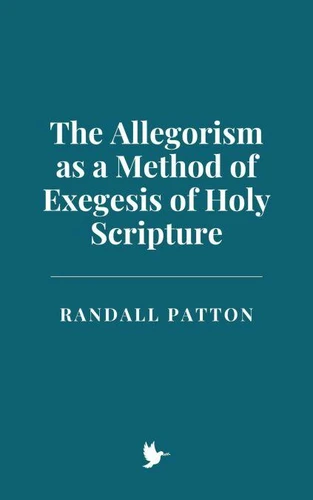
The Allegorism as a Method of Exegesis of Holy Scripture
Par :Formats :
Disponible dans votre compte client Decitre ou Furet du Nord dès validation de votre commande. Le format ePub est :
- Compatible avec une lecture sur My Vivlio (smartphone, tablette, ordinateur)
- Compatible avec une lecture sur liseuses Vivlio
- Pour les liseuses autres que Vivlio, vous devez utiliser le logiciel Adobe Digital Edition. Non compatible avec la lecture sur les liseuses Kindle, Remarkable et Sony
 , qui est-ce ?
Notre partenaire de plateforme de lecture numérique où vous retrouverez l'ensemble de vos ebooks gratuitement
Pour en savoir plus sur nos ebooks, consultez notre aide en ligne ici
C'est si simple ! Lisez votre ebook avec l'app Vivlio sur votre tablette, mobile ou ordinateur :

- FormatePub
- ISBN8230044048
- EAN9798230044048
- Date de parution13/02/2025
- Protection num.pas de protection
- Infos supplémentairesepub
- ÉditeurIndependently Published
Résumé
The concept of allegorism as a method of biblical exegesis has deep roots within the intellectual traditions of the ancient world. It draws on centuries of philosophical thought, religious practice, and interpretive theory. As an approach, allegory seeks to uncover hidden or deeper meanings in sacred texts, transcending the literal or surface-level interpretation. From the classical thinkers of antiquity to the Church Fathers and beyond, allegorism has played a pivotal role in shaping theological discourse and biblical scholarship.
Allegorism, at its core, operates on the assumption that divine truths are not always immediately evident and that the written word of Scripture can bear layers of meaning. It is a method of exegesis that enables the reader to approach texts not simply as historical accounts or ethical guidelines, but as expressions of divine wisdom that transcend time and space. Allegorical interpretation, in its earliest manifestations, was a product of both Jewish and Greek intellectual traditions.
It arose during a time when ancient philosophers sought to reconcile mythological or religious texts with philosophical and rational inquiry.
Allegorism, at its core, operates on the assumption that divine truths are not always immediately evident and that the written word of Scripture can bear layers of meaning. It is a method of exegesis that enables the reader to approach texts not simply as historical accounts or ethical guidelines, but as expressions of divine wisdom that transcend time and space. Allegorical interpretation, in its earliest manifestations, was a product of both Jewish and Greek intellectual traditions.
It arose during a time when ancient philosophers sought to reconcile mythological or religious texts with philosophical and rational inquiry.
A propos de Randall Patton


2,99 €

2,99 €

2,99 €

2,99 €


2,99 €


2,99 €
