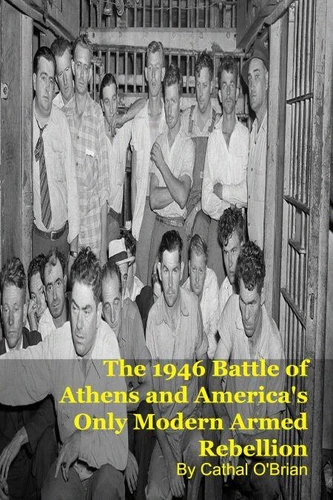
The 1946 Battle of Athens and America's Only Modern Armed RebellionThe Battle of Athens stands as the only successful armed rebellion on American soil since the Revolutionary War. In August 1946, approximately three hundred World War II veterans in McMinn County, Tennessee, took up military weapons and besieged their county jail in a six-hour firefight to recover ballot boxes stolen by a corrupt political machine.
This meticulously researched account reveals how Sheriff Paul Cantrell and his successor Pat Mansfield had spent a decade transforming law enforcement into organized theft through Tennessee's fee system, which paid deputies for each arrest they made. The machine rigged elections, shot an elderly farmer for attempting to vote, and ignored repeated appeals to federal authorities for intervention. When deputies transported ballot boxes to the jail for secret counting, the veterans raided National Guard armories, armed themselves with Garand rifles and Thompson submachine guns, and laid siege to the building with dynamite and thousands of rounds of ammunition.
Despite the violence, no one was killed. The veterans recovered the ballots, confirmed their electoral victory, and briefly established clean government before internal divisions undermined their reforms. This book examines the institutional decay that made armed resistance necessary, the moral reasoning behind the veterans' decision, and the complex legacy of using force to restore democracy.
The 1946 Battle of Athens and America's Only Modern Armed RebellionThe Battle of Athens stands as the only successful armed rebellion on American soil since the Revolutionary War. In August 1946, approximately three hundred World War II veterans in McMinn County, Tennessee, took up military weapons and besieged their county jail in a six-hour firefight to recover ballot boxes stolen by a corrupt political machine.
This meticulously researched account reveals how Sheriff Paul Cantrell and his successor Pat Mansfield had spent a decade transforming law enforcement into organized theft through Tennessee's fee system, which paid deputies for each arrest they made. The machine rigged elections, shot an elderly farmer for attempting to vote, and ignored repeated appeals to federal authorities for intervention. When deputies transported ballot boxes to the jail for secret counting, the veterans raided National Guard armories, armed themselves with Garand rifles and Thompson submachine guns, and laid siege to the building with dynamite and thousands of rounds of ammunition.
Despite the violence, no one was killed. The veterans recovered the ballots, confirmed their electoral victory, and briefly established clean government before internal divisions undermined their reforms. This book examines the institutional decay that made armed resistance necessary, the moral reasoning behind the veterans' decision, and the complex legacy of using force to restore democracy.


 , qui est-ce ?