Specializes in military history, intelligence operations, and Cold War geopolitics.
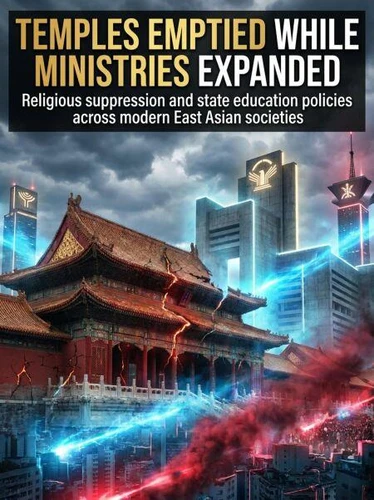
Temples Emptied While Ministries Expanded. Religious suppression and state education policies across modern East Asian societies
Par :Formats :
Disponible dans votre compte client Decitre ou Furet du Nord dès validation de votre commande. Le format ePub est :
- Compatible avec une lecture sur My Vivlio (smartphone, tablette, ordinateur)
- Compatible avec une lecture sur liseuses Vivlio
- Pour les liseuses autres que Vivlio, vous devez utiliser le logiciel Adobe Digital Edition. Non compatible avec la lecture sur les liseuses Kindle, Remarkable et Sony
 , qui est-ce ?
Notre partenaire de plateforme de lecture numérique où vous retrouverez l'ensemble de vos ebooks gratuitement
Pour en savoir plus sur nos ebooks, consultez notre aide en ligne ici
C'est si simple ! Lisez votre ebook avec l'app Vivlio sur votre tablette, mobile ou ordinateur :

- Nombre de pages173
- FormatePub
- ISBN978-3-565-48625-0
- EAN9783565486250
- Date de parution08/06/2026
- Protection num.pas de protection
- Taille1012 Ko
- Infos supplémentairesepub
- ÉditeurEmphaloz Publishing House
Résumé
Modern governments often viewed religious institutions not only as spiritual authorities, but as competing systems of loyalty capable of limiting centralized power. Across East Asia, campaigns for national modernization frequently unfolded through aggressive secularization policies aimed at bringing belief, education, and public morality under state supervision.
This book examines how twentieth-century governments restricted traditional religious life through legal reform, property confiscation, and ideological restructuring.
Temples, monasteries, and community shrines lost financial independence as authorities imposed new educational standards and political oversight. Religious instruction was gradually replaced by state-centered civic identity designed to strengthen national cohesion and administrative control. The narrative also traces the social consequences of weakening long-standing moral institutions. Urbanization, declining birth rates, and rising psychological isolation increasingly accompanied societies where traditional community structures lost influence.
Public order remained formally stable, yet many governments struggled to address the erosion of informal social bonds once maintained through shared ritual and local religious participation. By linking secularization to governance, education, and demographic change, the book presents East Asia not simply as a region of modernization, but as a laboratory for understanding what happens when states attempt to reorganize moral life itself.
Temples, monasteries, and community shrines lost financial independence as authorities imposed new educational standards and political oversight. Religious instruction was gradually replaced by state-centered civic identity designed to strengthen national cohesion and administrative control. The narrative also traces the social consequences of weakening long-standing moral institutions. Urbanization, declining birth rates, and rising psychological isolation increasingly accompanied societies where traditional community structures lost influence.
Public order remained formally stable, yet many governments struggled to address the erosion of informal social bonds once maintained through shared ritual and local religious participation. By linking secularization to governance, education, and demographic change, the book presents East Asia not simply as a region of modernization, but as a laboratory for understanding what happens when states attempt to reorganize moral life itself.