SOLDES
Jusqu'à -70% sur une sélection d'articles*

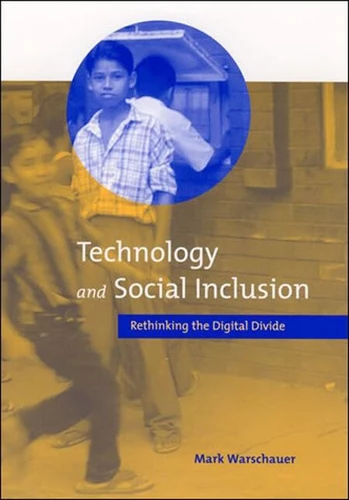
Technology and Social Inclusion. Rethinking the Digital Divide
Par :Formats :
Disponible dans votre compte client Decitre ou Furet du Nord dès validation de votre commande. Le format ePub protégé est :
- Compatible avec une lecture sur My Vivlio (smartphone, tablette, ordinateur)
- Compatible avec une lecture sur liseuses Vivlio
- Pour les liseuses autres que Vivlio, vous devez utiliser le logiciel Adobe Digital Edition. Non compatible avec la lecture sur les liseuses Kindle, Remarkable et Sony
- Non compatible avec un achat hors France métropolitaine
 , qui est-ce ?
Notre partenaire de plateforme de lecture numérique où vous retrouverez l'ensemble de vos ebooks gratuitement
Pour en savoir plus sur nos ebooks, consultez notre aide en ligne ici
C'est si simple ! Lisez votre ebook avec l'app Vivlio sur votre tablette, mobile ou ordinateur :

- Nombre de pages274
- FormatePub
- ISBN0-262-30369-8
- EAN9780262303699
- Date de parution17/09/2004
- Protection num.Adobe DRM
- Taille684 Ko
- Infos supplémentairesepub
- ÉditeurThe MIT Press
Résumé
Much of the discussion about new technologies and social equality has focused on the oversimplified notion of a "digital divide." Technology and Social Inclusion moves beyond the limited view of haves and have-nots to analyze the different forms of access to information and communication technologies. Drawing on theory from political science, economics, sociology, psychology, communications, education, and linguistics, the book examines the ways in which differing access to technology contributes to social and economic stratification or inclusion.
The book takes a global perspective, presenting case studies from developed and developing countries, including Brazil, China, Egypt, India, and the United States. A central premise is that, in today's society, the ability to access, adapt, and create knowledge using information and communication technologies is critical to social inclusion. This focus on social inclusion shifts the discussion of the "digital divide" from gaps to be overcome by providing equipment to social development challenges to be addressed through the effective integration of technology into communities, institutions, and societies.
What is most important is not so much the physical availability of computers and the Internet but rather people's ability to make use of those technologies to engage in meaningful social practices.
The book takes a global perspective, presenting case studies from developed and developing countries, including Brazil, China, Egypt, India, and the United States. A central premise is that, in today's society, the ability to access, adapt, and create knowledge using information and communication technologies is critical to social inclusion. This focus on social inclusion shifts the discussion of the "digital divide" from gaps to be overcome by providing equipment to social development challenges to be addressed through the effective integration of technology into communities, institutions, and societies.
What is most important is not so much the physical availability of computers and the Internet but rather people's ability to make use of those technologies to engage in meaningful social practices.