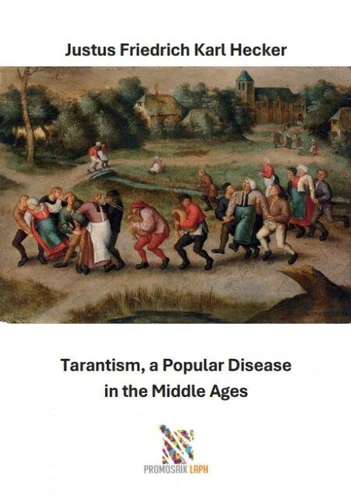
In 1832, the German medical doctor and writer, Justus Friedrich Karl Hecker (1795-1850) wrote the present research on the topic of tarantism ("Tanzwut", i.e. "dance rage/dance mania") which examines the phenomenon of tarantism in different geographical regions: Germany, Belgium, the Netherlands, France, Southern Italy (Apulia) and East Africa.
Tarantism is a universal phenomenon of the "feminine soul" across cultures.
For me as a woman, the topic of the dance rage/dance mania (scientifically referred to as tarantism) is a very personal topic around physicality, suppression of femininity and sexuality, misogynistic traditions, social dynamics and rebellion.
I recently translated into German the novel of the Italian journalist Giulio Di Luzio about a true story of a victim of dance mania in the region of Salento during the 1960s-1970s.
An interesting aspect is the association of the phenomenon with religion to control and limit it.
Religion is manipulated to restrict and control body and sexuality.
Religious rites are used to extinguish the "glow" of affected women. Saint Vitus became the patron saint of the dance-addicted women.
It was only in the epoch of humanism that medical research into the phenomenon began. And during this time, the phenomenon was finally got out of the corner of Satanism. Here, the author speaks of Paracelsus and his theory of tarantism/dance rage/dance mania at the interface between "medicine" and esotericism, according to which it can be attributed to three main causes: imagination, sensual desire and physical causes.
The "recovery" takes place through music therapy, restraining the minds of the women and their urge to move.
In the 2nd chapter, Hecker deals with the dance fury in southern Italy treated by the "Tarantella" music used to free the women from the dance rage.
In the next chapter, Hecker describes tarantism in East Africa while in the last chapter "Sympathy" he shows universal behaviour patterns around the world.
In 1832, the German medical doctor and writer, Justus Friedrich Karl Hecker (1795-1850) wrote the present research on the topic of tarantism ("Tanzwut", i.e. "dance rage/dance mania") which examines the phenomenon of tarantism in different geographical regions: Germany, Belgium, the Netherlands, France, Southern Italy (Apulia) and East Africa.
Tarantism is a universal phenomenon of the "feminine soul" across cultures.
For me as a woman, the topic of the dance rage/dance mania (scientifically referred to as tarantism) is a very personal topic around physicality, suppression of femininity and sexuality, misogynistic traditions, social dynamics and rebellion.
I recently translated into German the novel of the Italian journalist Giulio Di Luzio about a true story of a victim of dance mania in the region of Salento during the 1960s-1970s.
An interesting aspect is the association of the phenomenon with religion to control and limit it.
Religion is manipulated to restrict and control body and sexuality.
Religious rites are used to extinguish the "glow" of affected women. Saint Vitus became the patron saint of the dance-addicted women.
It was only in the epoch of humanism that medical research into the phenomenon began. And during this time, the phenomenon was finally got out of the corner of Satanism. Here, the author speaks of Paracelsus and his theory of tarantism/dance rage/dance mania at the interface between "medicine" and esotericism, according to which it can be attributed to three main causes: imagination, sensual desire and physical causes.
The "recovery" takes place through music therapy, restraining the minds of the women and their urge to move.
In the 2nd chapter, Hecker deals with the dance fury in southern Italy treated by the "Tarantella" music used to free the women from the dance rage.
In the next chapter, Hecker describes tarantism in East Africa while in the last chapter "Sympathy" he shows universal behaviour patterns around the world.