SOLDES
Jusqu'à -70% sur une sélection d'articles*

Nouveauté
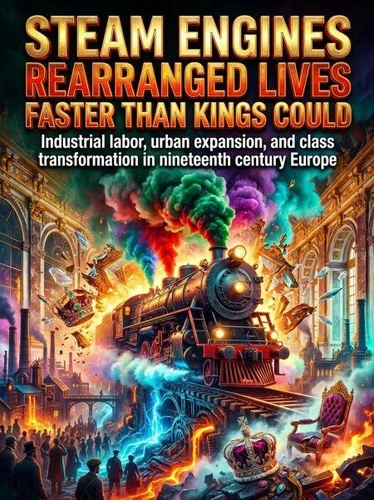
Steam Engines Rearranged Lives Faster Than Kings Could. Industrial labor, urban expansion, and class transformation in nineteenth century Europe
Par :Formats :
Disponible dans votre compte client Decitre ou Furet du Nord dès validation de votre commande. Le format ePub est :
- Compatible avec une lecture sur My Vivlio (smartphone, tablette, ordinateur)
- Compatible avec une lecture sur liseuses Vivlio
- Pour les liseuses autres que Vivlio, vous devez utiliser le logiciel Adobe Digital Edition. Non compatible avec la lecture sur les liseuses Kindle, Remarkable et Sony
 , qui est-ce ?
Notre partenaire de plateforme de lecture numérique où vous retrouverez l'ensemble de vos ebooks gratuitement
Pour en savoir plus sur nos ebooks, consultez notre aide en ligne ici
C'est si simple ! Lisez votre ebook avec l'app Vivlio sur votre tablette, mobile ou ordinateur :

- Nombre de pages225
- FormatePub
- ISBN978-3-565-47859-0
- EAN9783565478590
- Date de parution05/06/2026
- Protection num.pas de protection
- Taille1 Mo
- Infos supplémentairesepub
- ÉditeurEmphaloz Publishing House
Résumé
Europe changed more rapidly during the nineteenth century than many societies had changed in centuries before. Railways crossed borders, factories reshaped labor, and expanding cities pulled millions away from rural traditions into unfamiliar industrial economies. Political power increasingly followed economic transformation rather than inherited rank alone.
This book examines how industrialization altered the social structure of Europe between 1815 and 1914.
Aristocratic landholding elites gradually faced competition from industrial capitalists, urban professionals, and an expanding working class concentrated in rapidly growing cities. Factories reorganized daily life around mechanized production, while rail networks and telegraph systems accelerated trade, migration, and political communication across the continent. The narrative also explores the emergence of modern labor movements and class consciousness.
Workers confronted dangerous conditions, overcrowded housing, and unstable wages as industrial economies expanded unevenly. Socialist parties, trade unions, and reform campaigns developed in response to social tensions created by industrial growth itself. Europe's pursuit of power therefore unfolded not only through diplomacy and empire, but through profound changes in how ordinary people lived, worked, and understood their place within modern society.
Aristocratic landholding elites gradually faced competition from industrial capitalists, urban professionals, and an expanding working class concentrated in rapidly growing cities. Factories reorganized daily life around mechanized production, while rail networks and telegraph systems accelerated trade, migration, and political communication across the continent. The narrative also explores the emergence of modern labor movements and class consciousness.
Workers confronted dangerous conditions, overcrowded housing, and unstable wages as industrial economies expanded unevenly. Socialist parties, trade unions, and reform campaigns developed in response to social tensions created by industrial growth itself. Europe's pursuit of power therefore unfolded not only through diplomacy and empire, but through profound changes in how ordinary people lived, worked, and understood their place within modern society.