
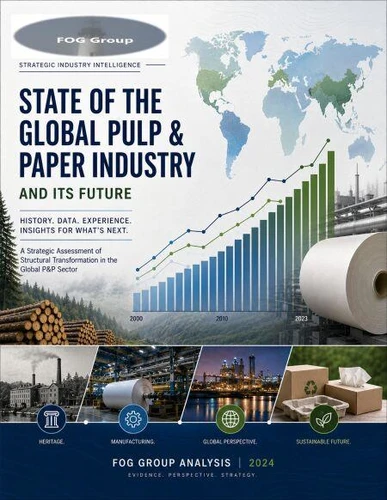
State of the Global Pulp & paper Industry and its Future
Par :Formats :
Disponible dans votre compte client Decitre ou Furet du Nord dès validation de votre commande. Le format ePub est :
- Compatible avec une lecture sur My Vivlio (smartphone, tablette, ordinateur)
- Compatible avec une lecture sur liseuses Vivlio
- Pour les liseuses autres que Vivlio, vous devez utiliser le logiciel Adobe Digital Edition. Non compatible avec la lecture sur les liseuses Kindle, Remarkable et Sony
 , qui est-ce ?
Notre partenaire de plateforme de lecture numérique où vous retrouverez l'ensemble de vos ebooks gratuitement
Pour en savoir plus sur nos ebooks, consultez notre aide en ligne ici
C'est si simple ! Lisez votre ebook avec l'app Vivlio sur votre tablette, mobile ou ordinateur :

- FormatePub
- ISBN8233156793
- EAN9798233156793
- Date de parution07/05/2026
- Protection num.pas de protection
- Infos supplémentairesepub
- ÉditeurLinda Balsamo
Résumé
This comprehensive report from FOG Group analyzes the structural transformation of the global pulp and paper industry from 1965 through a projected 2050. It documents the permanent decline of graphic papers due to digital disruption while highlighting the robust growth of packaging, tissue, and specialty fiber products. The analysis emphasizes a geographic shift in power, noting that while Western markets are rationalizing, Asia and South America are rapidly expanding their production and consumption footprint.
A significant portion of the text focuses on the circular economy, tracing how recovered paper has evolved from manufacturing waste into a critical, globally traded raw material. Ultimately, the sources argue that the industry's survival depends on operational excellence, asset conversion, and the strategic management of fiber migration across a changing global landscape. E-commerce is a central catalyst for the "global fiber migration, " a structural shift where fiber demand is reallocated from declining graphic papers (like newsprint and office paper) to growing "growth grades, " specifically packaging.
As the sources note, "the fiber that once filled a newspaper now wraps an e-commerce shipment". E-commerce drives this migration through several key mechanisms
A significant portion of the text focuses on the circular economy, tracing how recovered paper has evolved from manufacturing waste into a critical, globally traded raw material. Ultimately, the sources argue that the industry's survival depends on operational excellence, asset conversion, and the strategic management of fiber migration across a changing global landscape. E-commerce is a central catalyst for the "global fiber migration, " a structural shift where fiber demand is reallocated from declining graphic papers (like newsprint and office paper) to growing "growth grades, " specifically packaging.
As the sources note, "the fiber that once filled a newspaper now wraps an e-commerce shipment". E-commerce drives this migration through several key mechanisms