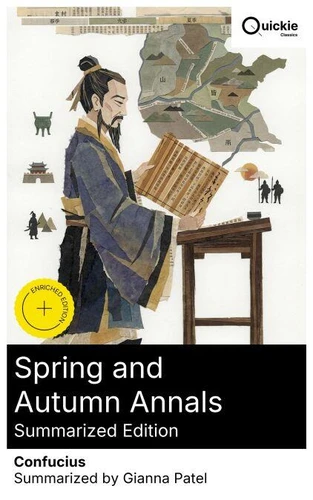
The Spring and Autumn Annals is a spare chronicle of the state of Lu, recording year by year and season by season events from 722 to 481 BCE. Entries on battles, rites, eclipses, and embassies are famously terse; their wording-the Spring-and-Autumn brush-carries praise and blame. As one of the Five Classics, it links early Chinese historiography with moral-political teaching, elaborated by the Zuozhuan, Gongyang, and Guliang.
Tradition attributes the compilation to Confucius (551-479 BCE) of Lu, whose brief service in office and long career as teacher aimed to restore Zhou ritual order. Drawing on state archives, he reportedly selected and phrased records to rectify names and guide rulers by indirection. Regardless of strict authorship, the text reflects his belief that moral governance begins with precise language and ritual propriety.
Readers of early Chinese statecraft, ethics, and historiography will find the Annals indispensable. Read it slowly, ideally with a commentary, attending to titles, honorifics, and omissions that signal judgment. Scholars of political theory and philology will value its disciplined brevity and its quiet claim that style itself can govern.
Quickie Classics summarizes timeless works with precision, preserving the author's voice and keeping the prose clear, fast, and readable-distilled, never diluted.
Enriched Edition extras: Introduction · Synopsis · Historical Context · Author Biography · Brief Analysis · 4 Reflection Q&As · Editorial Footnotes.
The Spring and Autumn Annals is a spare chronicle of the state of Lu, recording year by year and season by season events from 722 to 481 BCE. Entries on battles, rites, eclipses, and embassies are famously terse; their wording-the Spring-and-Autumn brush-carries praise and blame. As one of the Five Classics, it links early Chinese historiography with moral-political teaching, elaborated by the Zuozhuan, Gongyang, and Guliang.
Tradition attributes the compilation to Confucius (551-479 BCE) of Lu, whose brief service in office and long career as teacher aimed to restore Zhou ritual order. Drawing on state archives, he reportedly selected and phrased records to rectify names and guide rulers by indirection. Regardless of strict authorship, the text reflects his belief that moral governance begins with precise language and ritual propriety.
Readers of early Chinese statecraft, ethics, and historiography will find the Annals indispensable. Read it slowly, ideally with a commentary, attending to titles, honorifics, and omissions that signal judgment. Scholars of political theory and philology will value its disciplined brevity and its quiet claim that style itself can govern.
Quickie Classics summarizes timeless works with precision, preserving the author's voice and keeping the prose clear, fast, and readable-distilled, never diluted.
Enriched Edition extras: Introduction · Synopsis · Historical Context · Author Biography · Brief Analysis · 4 Reflection Q&As · Editorial Footnotes.

 , qui est-ce ?