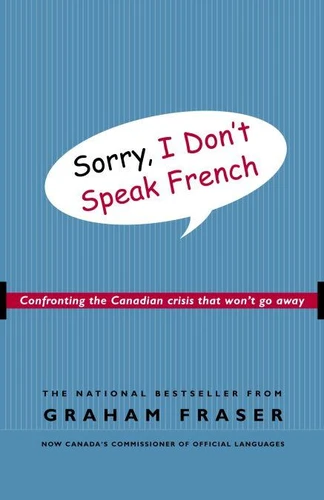
Sorry, I Don't Speak French. Confronting the Canadian Crisis That Won't Go Away
Par :Formats :
Disponible dans votre compte client Decitre ou Furet du Nord dès validation de votre commande. Le format ePub protégé est :
- Compatible avec une lecture sur My Vivlio (smartphone, tablette, ordinateur)
- Compatible avec une lecture sur liseuses Vivlio
- Pour les liseuses autres que Vivlio, vous devez utiliser le logiciel Adobe Digital Edition. Non compatible avec la lecture sur les liseuses Kindle, Remarkable et Sony
- Non compatible avec un achat hors France métropolitaine
 , qui est-ce ?
Notre partenaire de plateforme de lecture numérique où vous retrouverez l'ensemble de vos ebooks gratuitement
Pour en savoir plus sur nos ebooks, consultez notre aide en ligne ici
C'est si simple ! Lisez votre ebook avec l'app Vivlio sur votre tablette, mobile ou ordinateur :

- Nombre de pages352
- FormatePub
- ISBN978-1-55199-218-1
- EAN9781551992181
- Date de parution24/02/2009
- Protection num.Adobe DRM
- Taille795 Ko
- Infos supplémentairesepub
- ÉditeurDouglas Gibson Books
Résumé
As the threat of another Quebec referendum on independence looms, this book becomes important for every Canadian - especially as language remains both a barrier and a bridge in our divided country Canada's language policy is the only connection between two largely unilingual societies - English-speaking Canada and French-speaking Quebec. The country's success in staying together depends on making it work.
How well is it working? Graham Fraser, an English-speaking Canadian who became bilingual, decided to take a clear-eyed look at the situation. The results are startling - a blend of good news and bad. The Official Languages Act was passed with the support of every party in the House way back in 1969 - yet Canada's language policy is still a controversial, red-hot topic; jobs, ideals, and ultimately the country are at stake.
And the myth that the whole thing was always a plot to get francophones top jobs continues to live. Graham Fraser looks at the intentions, the hopes, the fears, the record, the myths, and the unexpected reality of a country that is still grappling with the language challenge that has shaped its history. He finds a paradox: after letting Quebec lawyers run the country for three decades, Canadians keep hoping the next generation will be bilingual - but forty years after learning that the country faced a language crisis, Canada's universities still treat French as a foreign language.
He describes the impact of language on politics and government (not to mention social life in Montreal and Ottawa) in a hard-hitting book that will be discussed everywhere, including the headlines in both languages.
How well is it working? Graham Fraser, an English-speaking Canadian who became bilingual, decided to take a clear-eyed look at the situation. The results are startling - a blend of good news and bad. The Official Languages Act was passed with the support of every party in the House way back in 1969 - yet Canada's language policy is still a controversial, red-hot topic; jobs, ideals, and ultimately the country are at stake.
And the myth that the whole thing was always a plot to get francophones top jobs continues to live. Graham Fraser looks at the intentions, the hopes, the fears, the record, the myths, and the unexpected reality of a country that is still grappling with the language challenge that has shaped its history. He finds a paradox: after letting Quebec lawyers run the country for three decades, Canadians keep hoping the next generation will be bilingual - but forty years after learning that the country faced a language crisis, Canada's universities still treat French as a foreign language.
He describes the impact of language on politics and government (not to mention social life in Montreal and Ottawa) in a hard-hitting book that will be discussed everywhere, including the headlines in both languages.