Jack N. Lightstone has been on the faculty of Concordia University in Montreal since 1976, where he currently holds the post of Provost and Vice-Rector, Research. His previous publications include Society, the Sacred, and Scripture in Ancient Judaism and The Rhetoric of the Babylonian Talmud, Its Social Meaning and Context.
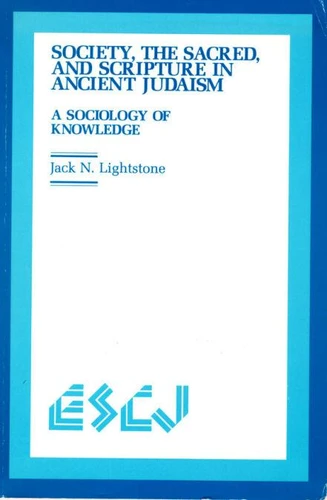
Society, the Sacred and Scripture in Ancient Judaism. A Sociology of Knowledge
Par :Formats :
Disponible dans votre compte client Decitre ou Furet du Nord dès validation de votre commande. Le format ePub est :
- Compatible avec une lecture sur My Vivlio (smartphone, tablette, ordinateur)
- Compatible avec une lecture sur liseuses Vivlio
- Pour les liseuses autres que Vivlio, vous devez utiliser le logiciel Adobe Digital Edition. Non compatible avec la lecture sur les liseuses Kindle, Remarkable et Sony
 , qui est-ce ?
Notre partenaire de plateforme de lecture numérique où vous retrouverez l'ensemble de vos ebooks gratuitement
Pour en savoir plus sur nos ebooks, consultez notre aide en ligne ici
C'est si simple ! Lisez votre ebook avec l'app Vivlio sur votre tablette, mobile ou ordinateur :

- Nombre de pages140
- FormatePub
- ISBN978-1-55458-733-9
- EAN9781554587339
- Date de parution30/10/2010
- Protection num.Digital Watermarking
- Taille256 Ko
- Infos supplémentairesepub
- ÉditeurWilfrid Laurier University Press
Résumé
This work explores the relationship between religion, social patterns, and the perception of the character of scripture in four modes of Ancient Judaism: (1) the Jerusalem community of the fifth to fourth centuries B. C. E. (ie, the Early Second Temple Period); (2) the Judaism of the Graeco-Roman Disapora down to the end of the fourth century of the Christian Era; (3) earliest rabbinic Judaism in the second century C.
E> in the land of Israel; (4) Late Antique Talmudic Rabbinism, primarily inn Babylonia, down to the sixth century of the Christian Era. Lightstone attempts not only to describe these perceptions and relationships but also to account for them, to explore why scripture should be thus perceived. His imaginative approach to the challenging descriptive and theoretical tasks is influenced by literary and form-critical methods as well as by the methods and perspectives of social anthropology and sociology of the mind.
This unique attempts at revising the perception of the character of scripture should arouse the interest of scholars and students of Ancient Judaism.
E> in the land of Israel; (4) Late Antique Talmudic Rabbinism, primarily inn Babylonia, down to the sixth century of the Christian Era. Lightstone attempts not only to describe these perceptions and relationships but also to account for them, to explore why scripture should be thus perceived. His imaginative approach to the challenging descriptive and theoretical tasks is influenced by literary and form-critical methods as well as by the methods and perspectives of social anthropology and sociology of the mind.
This unique attempts at revising the perception of the character of scripture should arouse the interest of scholars and students of Ancient Judaism.