
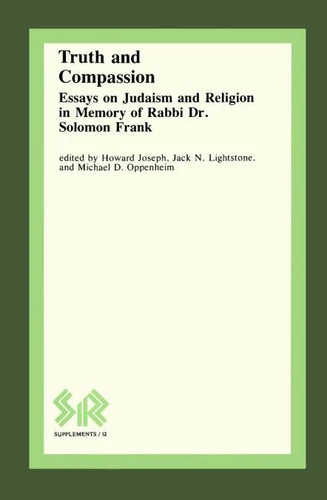
Truth and Compassion. Essays on Judaism and Religion in Memory of Rabbi Dr Solomon Frank
Par : , ,Formats :
Disponible dans votre compte client Decitre ou Furet du Nord dès validation de votre commande. Le format PDF est :
- Compatible avec une lecture sur My Vivlio (smartphone, tablette, ordinateur)
- Compatible avec une lecture sur liseuses Vivlio
- Pour les liseuses autres que Vivlio, vous devez utiliser le logiciel Adobe Digital Edition. Non compatible avec la lecture sur les liseuses Kindle, Remarkable et Sony
 , qui est-ce ?
Notre partenaire de plateforme de lecture numérique où vous retrouverez l'ensemble de vos ebooks gratuitement
Pour en savoir plus sur nos ebooks, consultez notre aide en ligne ici
C'est si simple ! Lisez votre ebook avec l'app Vivlio sur votre tablette, mobile ou ordinateur :

- Nombre de pages224
- FormatPDF
- ISBN0-88920-751-8
- EAN9780889207516
- Date de parution01/01/2006
- Protection num.Digital Watermarking
- Taille12 Mo
- Infos supplémentairespdf
- ÉditeurWilfrid Laurier University Press
Résumé
These essays represent a multidisciplinary approach to the study of religion and, especially, Judaism.
Setting aside common scholarly concerns with source criticism and history of interpretation, Shimon Levy argues that in Numbers 11 the redactor has forged diverse elements into a unity. Observing that much of what is said about Second Commonwealth Judaic culture is speculative, Jack Lightstone calls for radical revision of accepted portrayals of the period.
Ira Robinson's study of al-Kirkisani's effort to differentiate magic and miracle while demonstrating the rationality of belief in miracle locates his thoughts in the context of Rabbinic and Muslim treatments of the subject. While historians of modern Judaism have acknowledged in the influence of Kant and Hegel, Rousseau, contends Michel Despland, is often overlooked; he opened the way for changes in social and religious life.
In Walter Benjamin's philosophy of history Charles Davis finds a significant combining of elements from Kabbalistic and Marxist thought. Michael Oppenheim finds a common core of concerns addressed by modern Jewish philosophers: a struggle with modernity, identification with Jewish thought and values, and commitment to their Jewish communities. Gershon Hundert's "Reflections on the 'Whig' Interpretation of Jewish History" argues-vis-à-vis the Jerusalem school of Zionist historians-that the responsibility of national historians to their community can be fulfilled only by repudiating ideologies that may stand in the way of the search for truth. Howard Joseph's survey of teh extensive literature on the Holocaust indicates the options the authors find most worthy of continued focus.
Jerome Eckstein critically examines one of the few published pieces by Joseph Soloveitchik, who combines the Talmudic genius of the Lithuanian Yeshiva world with mastery of the Western intellectual tradition. B. Barry Levy's study of the Artscroll series of translations of and commentaries on biblical literature examines the assumptions and methodology of the series and the hidden agenda that emerges. Frederick Bird's comparison of charity ethics in Judaism and Christianity draws attention to the imprint on these ethics of the formative period of each religion. The volume will be of interest to student of the Bible, Judaism, and Christianity.
Ira Robinson's study of al-Kirkisani's effort to differentiate magic and miracle while demonstrating the rationality of belief in miracle locates his thoughts in the context of Rabbinic and Muslim treatments of the subject. While historians of modern Judaism have acknowledged in the influence of Kant and Hegel, Rousseau, contends Michel Despland, is often overlooked; he opened the way for changes in social and religious life.
In Walter Benjamin's philosophy of history Charles Davis finds a significant combining of elements from Kabbalistic and Marxist thought. Michael Oppenheim finds a common core of concerns addressed by modern Jewish philosophers: a struggle with modernity, identification with Jewish thought and values, and commitment to their Jewish communities. Gershon Hundert's "Reflections on the 'Whig' Interpretation of Jewish History" argues-vis-à-vis the Jerusalem school of Zionist historians-that the responsibility of national historians to their community can be fulfilled only by repudiating ideologies that may stand in the way of the search for truth. Howard Joseph's survey of teh extensive literature on the Holocaust indicates the options the authors find most worthy of continued focus.
Jerome Eckstein critically examines one of the few published pieces by Joseph Soloveitchik, who combines the Talmudic genius of the Lithuanian Yeshiva world with mastery of the Western intellectual tradition. B. Barry Levy's study of the Artscroll series of translations of and commentaries on biblical literature examines the assumptions and methodology of the series and the hidden agenda that emerges. Frederick Bird's comparison of charity ethics in Judaism and Christianity draws attention to the imprint on these ethics of the formative period of each religion. The volume will be of interest to student of the Bible, Judaism, and Christianity.