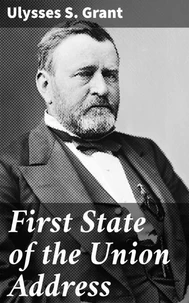
Second State of the Union Address. A Seminal Political Text on Reconstruction, Civil Rights, and Unity in America's Post-Civil War Era
Par :Formats :
Disponible dans votre compte client Decitre ou Furet du Nord dès validation de votre commande. Le format ePub est :
- Compatible avec une lecture sur My Vivlio (smartphone, tablette, ordinateur)
- Compatible avec une lecture sur liseuses Vivlio
- Pour les liseuses autres que Vivlio, vous devez utiliser le logiciel Adobe Digital Edition. Non compatible avec la lecture sur les liseuses Kindle, Remarkable et Sony
 , qui est-ce ?
Notre partenaire de plateforme de lecture numérique où vous retrouverez l'ensemble de vos ebooks gratuitement
Pour en savoir plus sur nos ebooks, consultez notre aide en ligne ici
C'est si simple ! Lisez votre ebook avec l'app Vivlio sur votre tablette, mobile ou ordinateur :

- Nombre de pages23
- FormatePub
- ISBN406-4-06-644113-5
- EAN4064066441135
- Date de parution08/12/2020
- Protection num.Digital Watermarking
- Taille482 Ko
- Infos supplémentairesepub
- ÉditeurGOOD PRESS
Résumé
Ulysses S. Grant's "Second State of the Union Address" stands as a pivotal document in American political literature, presenting a comprehensive account of the nation in the post-Civil War era. This address is marked by Grant's clear and direct prose, reflecting the urgency of his administration's challenges, including reconstruction efforts, civil rights, and economic recovery. Engaging with themes of unity and progress, Grant articulates the need for national cohesion in a fractured society, making this text a vital artifact for understanding the complexities of American democracy at a crucial juncture in its history.
Ulysses S. Grant, the 18th President of the United States, brought his military experience and commitment to national healing to the presidency. His leadership during the Civil War, coupled with his firsthand observations of the struggles faced by Reconstruction-era America, informed his vision for a nation recovering from deep divisions. Grant's personal narrative of overcoming adversity aligns with the themes of resilience and unity articulated in his address, making it a reflection of his character and political philosophy.
I recommend Grant's "Second State of the Union Address" not only for its historical significance but also for its eloquent expression of a leader striving for a better America. Readers interested in political history, leadership, and the moral imperatives of governance will find this address an insightful and compelling read.
Ulysses S. Grant, the 18th President of the United States, brought his military experience and commitment to national healing to the presidency. His leadership during the Civil War, coupled with his firsthand observations of the struggles faced by Reconstruction-era America, informed his vision for a nation recovering from deep divisions. Grant's personal narrative of overcoming adversity aligns with the themes of resilience and unity articulated in his address, making it a reflection of his character and political philosophy.
I recommend Grant's "Second State of the Union Address" not only for its historical significance but also for its eloquent expression of a leader striving for a better America. Readers interested in political history, leadership, and the moral imperatives of governance will find this address an insightful and compelling read.
A propos de Ulysses S. Grant








0,99 €