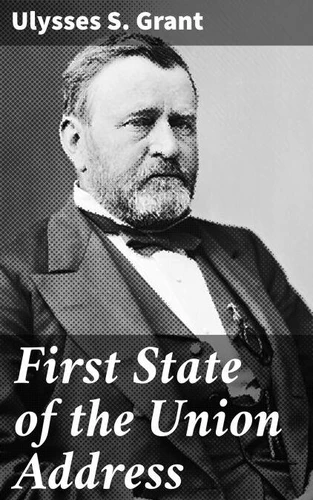
First State of the Union Address. A Presidential Vision for Unity and Progress in Post-Civil War America
Par :Formats :
Disponible dans votre compte client Decitre ou Furet du Nord dès validation de votre commande. Le format ePub est :
- Compatible avec une lecture sur My Vivlio (smartphone, tablette, ordinateur)
- Compatible avec une lecture sur liseuses Vivlio
- Pour les liseuses autres que Vivlio, vous devez utiliser le logiciel Adobe Digital Edition. Non compatible avec la lecture sur les liseuses Kindle, Remarkable et Sony
 , qui est-ce ?
Notre partenaire de plateforme de lecture numérique où vous retrouverez l'ensemble de vos ebooks gratuitement
Pour en savoir plus sur nos ebooks, consultez notre aide en ligne ici
C'est si simple ! Lisez votre ebook avec l'app Vivlio sur votre tablette, mobile ou ordinateur :

- Nombre de pages21
- FormatePub
- ISBN406-4-06-641668-3
- EAN4064066416683
- Date de parution08/12/2020
- Protection num.Digital Watermarking
- Taille470 Ko
- Infos supplémentairesepub
- ÉditeurGOOD PRESS
Résumé
In his inaugural First State of the Union Address, Ulysses S. Grant deftly navigates the intricacies of post-Civil War America, presenting a nation in need of unity and healing. Grant's prose is marked by clarity and earnestness, echoing the literary style of the early American republic while confronting contemporary societal challenges. The address emphasizes themes of reconciliation, the need for civil rights, and the expansion of the country, contextualizing his presidency within the broader narrative of a reconciled Union striving for progress amidst the shadows of division and trauma.
Ulysses S. Grant, best known as a victorious general in the Civil War, approached the presidency as a leader committed to rebuilding a fractured nation. His experiences on the battlefield undoubtedly shaped his perspective on issues of governance, particularly regarding civil rights and state responsibilities after such a pivotal conflict. Grant's tenure was characterized by a deep belief in the potential for democracy, and his reflections during this address reveal a thoughtful response to the political and social climate of his time.
Readers interested in American history, political rhetoric, or the evolution of civil rights will find Grant's address both compelling and essential. It serves as a foundational document for understanding the aspirations and challenges of Reconstruction, making it a critical resource for anyone seeking insight into the era's political landscape and the enduring promise of the American experiment.
Ulysses S. Grant, best known as a victorious general in the Civil War, approached the presidency as a leader committed to rebuilding a fractured nation. His experiences on the battlefield undoubtedly shaped his perspective on issues of governance, particularly regarding civil rights and state responsibilities after such a pivotal conflict. Grant's tenure was characterized by a deep belief in the potential for democracy, and his reflections during this address reveal a thoughtful response to the political and social climate of his time.
Readers interested in American history, political rhetoric, or the evolution of civil rights will find Grant's address both compelling and essential. It serves as a foundational document for understanding the aspirations and challenges of Reconstruction, making it a critical resource for anyone seeking insight into the era's political landscape and the enduring promise of the American experiment.
A propos de Ulysses S. Grant








0,99 €