Richard Vinen is Professor of History at King's College, London and the author of a number of major books. He won the Wolfson Prize for History for National Service (2014).
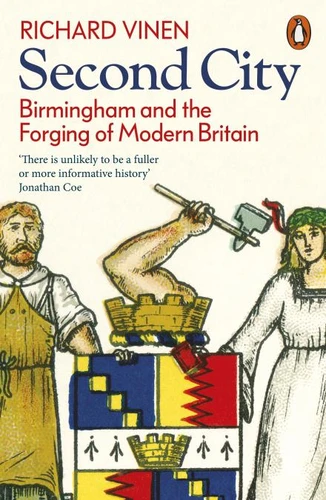
Second City. Birmingham and the Forging of Modern Britain
Par :Formats :
Disponible dans votre compte client Decitre ou Furet du Nord dès validation de votre commande. Le format ePub protégé est :
- Compatible avec une lecture sur My Vivlio (smartphone, tablette, ordinateur)
- Compatible avec une lecture sur liseuses Vivlio
- Pour les liseuses autres que Vivlio, vous devez utiliser le logiciel Adobe Digital Edition. Non compatible avec la lecture sur les liseuses Kindle, Remarkable et Sony
- Non compatible avec un achat hors France métropolitaine
 , qui est-ce ?
Notre partenaire de plateforme de lecture numérique où vous retrouverez l'ensemble de vos ebooks gratuitement
Pour en savoir plus sur nos ebooks, consultez notre aide en ligne ici
C'est si simple ! Lisez votre ebook avec l'app Vivlio sur votre tablette, mobile ou ordinateur :

- Nombre de pages592
- FormatePub
- ISBN978-0-241-45456-5
- EAN9780241454565
- Date de parution01/09/2022
- Protection num.Adobe DRM
- Infos supplémentairesepub
- ÉditeurPENGUIN
Résumé
A DAILY TELEGRAPH BOOK OF THE YEAR 2022'There is unlikely to be a fuller or more informative history of Birmingham than Vinen's' Jonathan Coe, Financial Times'Vinen has written a history of Birmingham, but it is also a theory of Birmingham. And also, perhaps, a theory of England. I buy it' Daily TelegraphFor over a century, Birmingham has been the second largest town in England. In his richly enjoyable new book Richard Vinen captures the drama of a small village that grew to become the quintessential city of the twentieth century: a place of mass production and full employment that began in the 1930s, but which came to a cataclysmic halt in the 1980s.
Birmingham has also been a magnet for migration, drawing in people from Wales, Ireland, India, Pakistan and the Caribbean. Indeed, much of British history can be explained, in large measure, with reference to Birmingham. Vinen roots his sweeping story in the experience of individuals. This is a book about figures everyone has heard of, from J. R. R. Tolkien to Duran Duran, and also about those that everyone ought to have heard of.
It captures the ways in which hundreds of thousands of people - from the Welsh miners who poured into the car factories in the 1930s to the young women who danced to reggae in the basement of Rebecca's nightclub in the 1980s - were caught up in the convulsions of social change. Birmingham is not a pretty place, and its history does not always make for comfortable reading. But modern Britain does not make sense without it.
Birmingham has also been a magnet for migration, drawing in people from Wales, Ireland, India, Pakistan and the Caribbean. Indeed, much of British history can be explained, in large measure, with reference to Birmingham. Vinen roots his sweeping story in the experience of individuals. This is a book about figures everyone has heard of, from J. R. R. Tolkien to Duran Duran, and also about those that everyone ought to have heard of.
It captures the ways in which hundreds of thousands of people - from the Welsh miners who poured into the car factories in the 1930s to the young women who danced to reggae in the basement of Rebecca's nightclub in the 1980s - were caught up in the convulsions of social change. Birmingham is not a pretty place, and its history does not always make for comfortable reading. But modern Britain does not make sense without it.